
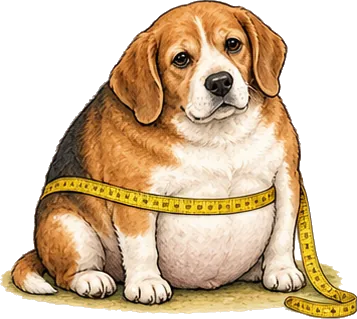
Most owners can't tell by eye. In a 2022 U.S. clinic survey, veterinarians scored 59% of dogs as overweight or obese, and 36% of the owners of those dogs described their dog's body as normal.1 The scale alone won't settle it either, since 70 pounds can be lean on a tall, big-framed Lab and heavy on a small-framed one. The reliable answer comes from your hands: a short rib, waist, and belly check that maps onto the 9-point body condition score vets use.
The 9-point body condition score in plain terms
The World Small Animal Veterinary Association (WSAVA) chart grades dogs from 1 (emaciated) to 9 (severely obese), with 4 and 5 as the ideal range.2 AAHA treats each point above 5 as roughly 10% extra body weight, so a dog at 7 is carrying about 20% more than it should.3 That rule of thumb is what turns a score into a goal weight, though AAHA cautions it is unproven for very heavy dogs and may set the goal too high for them.3
| Score | Ribs | Waist from above | Belly from the side | Rough excess weight (10%-per-point rule) |
|---|---|---|---|---|
| 3 (thin) | Easy to feel, may be visible, no fat over them | Obvious | Strong tuck | Under ideal |
| 4 (ideal) | Easy to feel with a thin fat layer | Easy to see | Tucked up | 0% |
| 5 (ideal) | Felt without excess fat | Visible behind ribs | Tucked up | 0% |
| 6 | Felt under a slight extra fat layer | Visible but not prominent | Tuck still present | About 10% |
| 7 | Hard to feel under heavy fat | Barely visible or gone | Tuck may remain; fat at base of tail | About 20% |
| 8 | Not felt, or only with firm pressure | Absent | No tuck; belly may look swollen | About 30% (estimate; may be more) |
| 9 | Buried under massive fat | Absent | Distended; fat on neck and legs | 40% or more (estimate only) |
Descriptions are paraphrased from the WSAVA canine chart;2 the excess-weight column extends the AAHA 10%-per-point estimate, which is only a rough guide at scores of 8 and 9.3
How to check your dog at home in two minutes
Do this with the dog standing, ideally after a bath or on a short-coated day, since fluffy breeds hide a lot. Write the result down so you can compare next month.
- Rib check. Lay your flat palms on both sides of the chest and slide them gently front to back. On a dog at 4 or 5, you can feel each rib with light pressure through only a thin covering of fat. A slight extra layer you have to work through points to 6. Needing to press hard to find them at all puts the dog at 7 or higher.2
- Waist check. Stand over the dog and look down. Behind the last rib, the body should narrow before the hips. A waist you can see but that isn't prominent fits a 6. When the waist is barely visible or gone, think 7 or higher.2
- Tuck check. Crouch to the side. The belly line should rise from the chest toward the back legs. A level or sagging belly means fat is sitting in the abdomen.
- Tail-base and back check. Run a hand over the lower back and the base of the tail. Soft padding you can pinch there is one of the markers WSAVA lists for scores of 7 and above.2
Breed shape matters. Greyhounds and Whippets often show some rib at a healthy weight, while Bulldogs and Pugs rarely show a dramatic tuck. Feel matters more than look for those dogs. The breed pages in our breed directory list typical adult weight ranges, and the dog weight calculator shows where your dog sits against them. Treat breed ranges as a starting point, though; the hand check beats the chart when the two disagree.
Muscle condition: the part owners skip
Fat and muscle are scored separately. WSAVA's muscle condition score grades dogs as normal, mild, moderate, or severe loss, based on how the spine, shoulder blades, skull, and hip bones feel.4 The first place muscle disappears is usually along both sides of the spine.4 An overweight dog can still be losing muscle, so feel for a ridge of spine that stands out more than it used to, especially in older dogs. That pattern is worth raising with your vet before you cut calories, since a diet that strips muscle along with fat is the wrong outcome. Our guide on when a dog is a senior covers the age ranges where muscle loss becomes common.
What extra weight does to a dog's health and lifespan
The strongest evidence comes from a lifetime study of 48 Labrador Retrievers. Researchers paired littermates and fed one dog in each pair 25% less than its partner, starting at 8 weeks old.5 The leaner dogs had a median lifespan of 13 years, compared with 11.2 years for their heavier siblings, a gap of 1.8 years.6 Chronic disease also showed up later in the restricted group,5 and they needed osteoarthritis treatment about 3 years later than the controls.6
The heavier dogs were described as uniformly overweight, and the only planned difference from their siblings was how much food they got.6 A modest surplus, held for years, was enough to shorten their lives. AAHA also lists orthopedic disease and endocrine disorders among the problems that travel with excess weight and should be checked when a weight plan starts.3
A safe weight-loss plan, step by step
- Get a vet weigh-in and score. You need a starting weight on an accurate scale and a body condition score from someone who does it daily. This also gives your vet the chance to look for medical causes first.
- Estimate the goal weight. Divide the current weight by 1 plus 10% for each point above 5. A dog at 7 weighing 80 pounds has a goal near 80 / 1.2. For a dog at 8 or 9, let your vet set the goal, since the rule gets less reliable there.3
- Set the calorie target at goal weight. The site's dog food calculator uses AAHA's formula: resting energy requirement (RER) = 70 x (goal weight in kg)0.75, multiplied by a weight-loss factor of 1.0.7 Using goal weight, not current weight, is what creates the deficit.
- Budget treats inside that number. Treats can be up to 10% of daily calories.3 Subtract them before you measure the food.
- Measure food by weight. A kitchen scale in grams is far more consistent than a scoop. Divide the food's kcal per cup or per kg (printed on the bag) into your daily budget.
- Add walking slowly. For a dog without joint problems, AAHA suggests three 5-minute walks a day to start, working up to a total of 30 to 45 minutes daily.3
- Weigh every 2 weeks. Aim for a loss of 1% to 2% of body weight per week.3 AAHA recommends checking in after the first week and then every 2 weeks until the rate is steady.3
- Adjust, don't guess. If you are following the plan and nothing moves, AAHA's guidance is to cut calories by 10% to 20% or change activity. When the dog drops faster than 2% a week, add about 10% back.3 Run either change past your vet.
Worked example: an 80-pound Lab at a score of 7
Take a neutered Labrador that weighs 80 lb and scores 7.
- Excess weight: 2 points above 5, so about 20% over ideal.
- Goal weight: 80 / 1.20 = 66.7 lb. In kilograms, 66.7 / 2.2046 = 30.2 kg.
- RER at goal: 30.20.75 is about 12.9. Then 70 x 12.9 = 903 kcal per day. With the 1.0 weight-loss factor, the daily budget is about 900 kcal.
- Treat allowance: 10% of 900 = 90 kcal. That leaves 810 kcal for meals.
- Food amount: With a kibble at 350 kcal per cup, 810 / 350 = 2.3 cups per day, or a little over 1 cup per meal on two meals.
- Weekly target: 1% to 2% of 80 lb = 0.8 to 1.6 lb per week.
- Timeline: The dog needs to lose 13.3 lb. At 1.6 lb per week that takes about 8 weeks; at 0.8 lb per week, about 17. Plan on 3 to 4 months.
For comparison, the same dog's maintenance at its current 80 lb (36.3 kg, factor 1.4) works out to roughly 1,450 kcal. The plan trims more than 500 kcal a day, which is why it works without being extreme. Exercise adds a little: a dog burns about 1.1 kcal per kg of body weight for each kilometer walked briskly,3 so a 3 km walk for this dog burns about 1.1 x 36.3 x 3 = 120 kcal. Walking helps, but the food budget does most of the work.
As the dog gets lighter, recheck the score. Once it reaches 5, switch to a maintenance factor (1.4 to 1.6 for a neutered adult) at the new weight and keep weighing monthly.3
Where weight-loss plans usually go wrong
- Using current weight in the formula. Calories figured at 80 lb will hold the dog at 80 lb.
- Cutting the bag-feeding chart in half. The chart on the bag gives a broad range for an average dog, not yours. Start from RER at goal weight instead.
- Forgetting the extras. Dental chews, training treats, table scraps, and the toddler's dropped crackers all count. Large dental chews and bully sticks can eat up a surprising share of the day's budget, so check the kcal per piece on the label.
- Swapping treats for people food blindly. Carrot and green bean pieces are fine low-calorie swaps, but grapes and raisins are not safe. See foods toxic to dogs before experimenting.
- Losing too fast. Stay at or under 2% a week, the top of AAHA's range for dogs, and keep feeling for muscle along the spine as the pounds come off.3
- Stopping at the goal. Going straight back to old portions tends to bring the weight back. Recalculate for maintenance and keep the monthly weigh-in.
Tracking that keeps the plan honest
Keep one log with the date, weight, body condition score, daily calories, and any changes. Weigh at the same time of day on the same scale. For small dogs, weigh yourself holding the dog and subtract your own weight; for large dogs, many clinics will let you use the lobby scale if you call ahead. A photo from above and from the side every month makes the waist change easy to see. If spaying or neutering is coming up, note it, because the site's calculators drop the adult factor from 1.6-1.8 for intact dogs to 1.4-1.6 for neutered ones; our guide on when to spay or neuter covers the timing.
When to see a vet before or during a diet
Some weight gain isn't about food. Hypothyroidism is the classic example: it shows up mainly in middle-aged dogs (roughly ages 4 to 10) of medium and large breeds, and typical signs include weight gain without a bigger appetite, low energy, seeking warm spots, and thinning hair on both sides of the body.8 AAHA also names hyperadrenocorticism (Cushing's disease) as a condition that can slow weight loss.3 Call your vet before starting a plan if any of these apply:
- The dog gained weight while eating the same amount or less.
- Thirst, urination, or appetite has changed noticeably.
- The belly looks swollen or pot-bellied while the back and legs look thin.
- Limping, reluctance to jump, or tiring after short walks has started.
- There's no loss after 4 weeks of measured feeding.
- The dog is losing more than 2% a week, or refuses food for more than a day.
Puppies are a separate case. They should never be put on a weight-loss diet without a vet, because their calorie needs are built around growth; see how much to feed a puppy for the growth-stage factors.
Common questions
How many pounds overweight is my dog?
Use the body condition score. On the 9-point scale, each point above 5 is roughly 10% extra weight. A 60-pound dog scored at 7 is about 20% over, so its ideal weight is close to 60 divided by 1.2, or 50 pounds, meaning about 10 pounds to lose. Have your vet confirm the score, since breed shape and coat can fool a home check.
How fast should an overweight dog lose weight?
AAHA guidance for dogs is 1% to 2% of body weight per week. For a 50-pound dog that is 0.5 to 1 pound a week. Faster loss is a reason to add some calories back, and no loss after you've checked your measuring may mean the budget needs a 10% to 20% trim. Weigh every 2 weeks so you can see the trend rather than day-to-day swings.
How many calories should my dog eat to lose weight?
The site's calculators use AAHA's formula: 70 x (goal weight in kg)^0.75, with a weight-loss factor of 1.0. For a dog whose goal weight is 20 kg (44 lb), that is 70 x 9.46, or about 660 kcal per day, including treats. The dog food calculator does the math for any weight.
Can I feel my dog's ribs if it is a healthy weight?
Yes. At an ideal score of 4 or 5, you should feel each rib with light pressure through a thin layer of fat, without seeing them on most breeds. If you need to press firmly to find them, the dog is likely at 7 or above. Sighthounds are a common exception, since a little visible rib is often normal for them.
Can a thyroid problem make my dog fat?
It can. Hypothyroidism is most common in medium and large dogs aged 4 to 10 and often shows as weight gain without a bigger appetite, low energy, seeking warmth, and thinning hair on both flanks. A blood test is needed to tell. If your dog gained weight while eating the same amount, ask your vet to check before starting a diet.
See Slow feeders and puzzle feeders on Amazon. As an Amazon Associate we earn from qualifying purchases.
 Sources
- Association for Pet Obesity Prevention, 2022 State of U.S. Pet Obesity Report, 2022
- WSAVA Global Nutrition Committee, Body Condition Score chart (dogs and cats), 2013
- Brooks D, Churchill J, Fein K, et al., 2014 AAHA Weight Management Guidelines for Dogs and Cats, JAAHA 2014
- WSAVA Global Nutrition Committee / Tufts University, Muscle Condition Score chart, 2013
- Kealy RD, Lawler DF, Ballam JM, et al., Effects of diet restriction on life span and age-related changes in dogs, JAVMA 2002
- Penn Today (University of Pennsylvania), Study finds dogs fed reduced-calorie diet live nearly two years longer, 2002
- AAHA, 2021 AAHA Nutrition and Weight Management Guidelines: Weight Reduction in the Obese Pet, 2021
- Merck Veterinary Manual (Pet Owner Version), Disorders of the Thyroid Gland in Dogs
General information, not veterinary advice. If your pet is unwell, call your vet.
