
Home › Guides › How Much Water Should a Dog Drink a Day?
How Much Water Should a Dog Drink a Day?
A healthy adult dog usually drinks 50 to 80 mL of water per kilogram a day, roughly an ounce per pound. Vets look for a cause above 100 mL/kg, and a 24-hour measurement at home shows which side your dog is on.
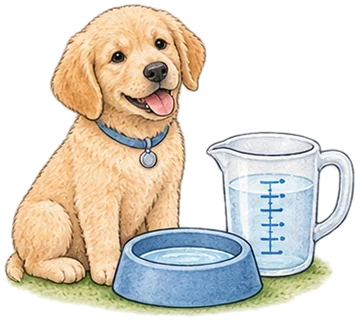
Healthy adult dogs on dry food usually drink about 50 to 80 mL of water per kilogram of body weight a day, which is 0.8 to 1.2 fluid ounces per pound.12 For a 50-pound dog that is roughly 5 to 8 cups. The familiar rule of one ounce per pound (about 65 mL/kg) sits in the middle of that band, which comes from one specialist's teaching slides but fits the little measured data. Vets begin to call thirst excessive, a sign known as polydipsia, once a dog drinks more than 100 mL/kg a day, about 1.5 ounces per pound.34
How many cups a day, by weight
This table turns the 50 to 80 mL/kg band into US cups (one cup is 236.6 mL). The calorie column uses about 1 mL of water per calorie, which Zanghi and Gardner describe as the National Research Council's conservative minimum, up to 1.4 mL, the top of the weekly averages they measured in dogs on plain tap water.1 Those ratios count all water, including about 0.1 mL per calorie the body makes from food, so the bowl's share runs roughly a tenth lower.1 Calories come from the dog food calculator's neutered-adult setting at 1.5 times resting energy, the middle of its 1.4 to 1.6 range. All columns assume dry food.
| Dog weight | Usual range, 50 to 80 mL/kg (cups) | From calories, neutered adult (cups) | Vets look closer above 100 mL/kg (cups) |
|---|---|---|---|
| 5 lb (2.3 kg) | 0.5 to 0.8 | 0.8 to 1.1 | 1.0 |
| 10 lb (4.5 kg) | 1.0 to 1.5 | 1.4 to 1.9 | 1.9 |
| 20 lb (9.1 kg) | 1.9 to 3.1 | 2.3 to 3.2 | 3.8 |
| 30 lb (13.6 kg) | 2.9 to 4.6 | 3.1 to 4.4 | 5.8 |
| 40 lb (18.1 kg) | 3.8 to 6.1 | 3.9 to 5.5 | 7.7 |
| 50 lb (22.7 kg) | 4.8 to 7.7 | 4.6 to 6.5 | 9.6 |
| 80 lb (36.3 kg) | 7.7 to 12.3 | 6.6 to 9.2 | 15.3 |
| 100 lb (45.4 kg) | 9.6 to 15.3 | 7.8 to 10.9 | 19.2 |
The two methods agree for mid-sized dogs and split at the ends, because resting energy rises with weight to the 0.75 power rather than in step with it.5 The 100 mL/kg line has no size adjustment,34 yet a 5-pound dog's calorie range already reaches its 1-cup line, and a 100-pound dog's line is about twice its calorie range. No source here measured toy or giant breeds, so this is only our arithmetic.
Why the published ranges disagree
| Source | What stands behind it | Normal or typical | Called excessive |
|---|---|---|---|
| Nelson, UC Davis, 20023 | Conference lecture notes, no references; dogs and cats | 20 to 70 mL/kg | Over 100 mL/kg |
| Della Maggiore, 20202 | One specialist's lecture slides, no source given for these figures; dogs and cats together | 50 to 80 mL/kg, with 80 to 100 a grey zone | Over 100 mL/kg |
| Schmid, 20234 | Peer-reviewed continuing education article | Not stated | Over 100 mL/kg |
| Merck Veterinary Manual5 | Reference text; most mammals' need at a comfortable (thermoneutral) temperature, not dogs specifically | About 44 to 66 mL/kg (no time unit, in a passage on daily needs) | Not stated |
| Zanghi and Gardner, 20181 | Measured total water (bowl, food and metabolic water), 16 small adult dogs on dry food at a Purina facility, baseline week | 71 mL/kg a day on average; 60 to 82 from day to day | Not studied |
By our reading, the ounce-per-pound rule, about 65 mL/kg, falls inside every range in the table, but the rows are not like for like. Merck's figure is a need for mammals in general. Zanghi and Gardner counted all water, not just the bowl, in 16 dogs averaging about 26 pounds, and gave 60 to 82 as day-to-day variation without saying how far single dogs spread.1 Nelson cites nothing for his 20 mL/kg floor.
What changes how much a healthy dog drinks
Dry food versus wet or fresh food
Merck puts canned food at 60% to over 87% water, against 3% to 11% for dry, and says dogs eating mostly canned food generally drink less.5 In a crossover study of ten beagles, run by staff of the company whose fresh food was tested, kibble at 6% water supplied 11 g of water a day and the dogs drank 423 g from the bowl; fresh food at 71% water supplied 375 g and the bowl fell to 147 g.6 The bowl dropped by 276 g while the food added 364 g, so the dogs offset about three-quarters of the new food water by drinking less. Total intake still rose by about a fifth: a fresh-fed dog can drink a third as much from the bowl and still take in more water.6
Heat and exercise
The National Research Council's owner guide says a dog's water need rises with the energy it burns and can more than double when the weather is warm, and advises offering water during exercise.7 In a field study, seven Border Patrol dogs in Texas worked shifts averaging 5.7 hours at a median 85°F and 70% humidity. On each dog's plain-water day, with water offered every half hour, the dogs drank an average of 7 mL/kg an hour,8 about two-thirds of a cup an hour for a 50-pound dog. Over an average shift that comes to roughly 40 mL/kg, half or more of a usual day's intake, in under six hours.
Puppies
None of the sources above sets a puppy figure or says how the 100 mL/kg line applies to one. If the 1 mL per calorie rule carries over to growing dogs, a 10-pound puppy under 4 months old, at the calculator's 3.0 times resting energy for that age, needs about 650 calories and so roughly 650 mL (2.75 cups) of water a day, about 143 mL/kg. From 4 months to adulthood the calculator drops to 2.0 times, which gives a 10-pound puppy in that age range about 440 mL, or 97 mL/kg. Both sit near or above the 100 mL/kg line, so judge a puppy's drinking with your vet, not against that line.
Nursing mothers
No measured figure turned up for nursing dams either. A Purdue canine welfare sheet ranks water with calories as the nutrients a new mother needs most after whelping, and puts her at three times maintenance calories in weeks 3 and 4.9 The dog food calculator isn't built for nursing dogs, so ask your vet about her water and food, and see the pregnancy guide for how her needs peak 3 to 5 weeks after birth.
Measuring your dog's real intake over 24 hours
Schmid has owners measure daily intake for two to three days to set a baseline before a desmopressin trial, a test for one cause of heavy thirst, and notes that multi-pet homes make it harder.4
- Weigh your dog and divide pounds by 2.2 to get kilograms. Dividing the mL by pounds instead of kilograms makes the result look less than half its true size. The overweight guide covers weighing at home, and the dog weight calculator shows whether the number fits the breed.
- Choose an ordinary day, not a heat wave or a long hike.
- Use one bowl and a measuring jug. Note the start time, fill the bowl, and record the volume in mL.
- Record every top-up the same way, including water poured on walks, and wipe up spills. In a multi-pet home, give your dog its own room and bowl while you measure.
- At the same time the next day, pour what is left back into the jug and write it down.
- Intake is everything you poured in minus what was left. Divide by body weight in kilograms to get mL/kg, then average two or three days.
A worked example: 50 pounds
A 50-pound dog weighs 22.7 kg. On day 1 you fill the bowl with 1,000 mL at 8:00 a.m., add 750 mL at 1:00 p.m. and again at 6:30 p.m., and find 430 mL left at 8:00 the next morning. Intake is 1,000 + 750 + 750 minus 430, or 2,070 mL, and 2,070 divided by 22.7 is 91 mL/kg. Days 2 and 3 give 2,010 and 2,140 mL, so the three-day average is 2,073 mL (91 mL/kg), about 8.8 cups.
Against the first table, that dog is above the usual 4.8 to 7.7 cups and below the 9.6-cup line, in the 80 to 100 mL/kg band that Della Maggiore's slides call a grey zone, a label from one specialist rather than a tested cutoff.2 A dog can be abnormally thirsty without ever crossing 100, Schmid points out.4 The useful question is what changed: hotter weather, a switch from canned food to kibble, longer walks, or a dog that drank 5 cups a day last month. If nothing explains it, or the dog is peeing more too, take the log to your vet.
When drinking counts as too much
Vets draw the line at more than 100 mL/kg of water a day for polydipsia and more than 50 mL/kg of urine a day for polyuria.34 Urine cannot be measured reliably at home, so vets ask about the pattern: more trips outside, trouble lasting through the night, or puddles where the dog rests.4
Schmid names chronic kidney disease, diabetes mellitus, and hyperadrenocorticism (Cushing's disease) as the most common causes in dogs.4 Nelson's longer list for dogs and cats adds pyometra (an infected uterus in an unspayed female), high blood calcium, liver insufficiency, Addison's disease, kidney infection, low potassium, and psychogenic polydipsia (behavioral drinking).3 Medications count too, among them glucocorticoids (steroids) and loop diuretics.4
Nelson says a raised 24-hour intake calls for a search for the cause,3 and the senior-dog guide lists more drinking as a reason for an older dog to see the vet. Don't take the bowl away to see whether the number drops. Schmid calls water restriction extremely dangerous for these dogs, since some can dehydrate quickly without free access.4
What dehydration looks like
A dog that drinks can still fall behind if it loses fluid faster than it drinks, and Merck counts dehydration among the serious complications of many digestive, respiratory, and urinary disorders.5 Vets grade it as the share of body weight lost as water.10
| Body weight lost as water | Gums | Skin elasticity | Eyes and pulse |
|---|---|---|---|
| 4 to 5% | Semi-dry | Normal | Eyes moist |
| 6 to 7% | Dry | Mildly reduced | Eyes still moist |
| 8 to 10% | Dry | Considerably reduced | Eyes sunken; weak, rapid pulse |
Six percent of a 50-pound dog is 3 pounds, about 1.4 liters of fluid. The skin pinch stays normal until roughly the 6 to 7% band, so it misses early dehydration, and Merck lists cases where it misleads: chronically emaciated or geriatric dogs can show poor skin elasticity and sunken eyes while normally hydrated, very young animals have extra-elastic skin that makes the pinch hard to read, and drooling from nausea can wet the gums of a dehydrated dog.10
When to call the vet
Phone the same day for any of these:
- Dry or tacky gums or sunken eyes,10 or any weakness or collapse.
- Vomiting or diarrhea along with refusing water, since dehydration is a serious risk with digestive illness.5
- An unspayed female who is drinking heavily and seems unwell, because pyometra is among the causes.3
- Heavy thirst that began after your dog got into something it should not have. The toxic foods guide covers what to do first.
These can wait for a visit within the week:
- Two or three measured days above 100 mL/kg,34 or clearly above the calorie column for a very small dog.
- A steady rise over your dog's own normal, even if it stays under 100 mL/kg.34
- New nighttime accidents or extra trips outside along with the drinking.4
- Heavier drinking after a new medicine starts; ask the prescribing vet before changing the dose.4
Common questions
How long can a dog go without water?
Do not wait it out. Merck calls water the most important nutrient and says going without it can lead to death within days. A dog that refuses all water for a day, or that is vomiting or has diarrhea, should be seen by a vet. A dog eating canned food gets much of its water from the dish, so judge by gums and energy as well as the bowl.
Should I take my dog's water away at night?
For a healthy adult, no. Merck says healthy animals with plenty of water regulate their own intake, and that water generally should not be restricted. If nighttime accidents are the reason you are asking, mention them to your vet, because trouble lasting through the night is one of the signs vets ask about when a dog drinks too much. Ask before limiting a puppy's water.
How can I get my dog to drink more?
Moisture in food counts toward the total, so canned food or a splash of water over kibble helps. Merck lists canned food at 60% to over 87% water and says several water sources encourage drinking, which matters most for cats. Offer fresh water in more than one spot and bring it on walks. If a dog suddenly drinks far less than usual and seems tired, call your vet.
How do I work out cups for a dog that is not in the table?
Divide the weight in pounds by 2.2 to get kilograms, multiply by 50 and by 80 for the usual range in mL, then divide by 236.6 for cups. A 35-pound dog is 15.9 kg, so 795 to 1,272 mL, or 3.4 to 5.4 cups. Its 100 mL/kg line is 1,590 mL, about 6.7 cups. For very small or very large dogs, check the calorie column too.
My dog drinks more since starting prednisone. Is that normal?
It is a recognized effect. Schmid lists glucocorticoids, the steroid family that includes prednisone, among the causes of excessive thirst. Tell the prescribing vet how much your dog is drinking, keep water freely available, and do not stop or change the dose on your own. A measured daily intake gives the vet something concrete to work from.
See Dog water bowls on Amazon. As an Amazon Associate we earn from qualifying purchases.
 Sources
- Zanghi BM, Gardner CL, Total Water Intake and Urine Measures of Hydration in Adult Dogs Drinking Tap Water or a Nutrient-Enriched Water, Frontiers in Veterinary Science, 2018
- Della Maggiore A, Water, Water, Water: Diabetes Insipidus and Cushings Syndrome in the Dog and Cat, conference slides, 2020
- Nelson RW, University of California, Davis, Polyuria, Polydipsia and Diabetes Insipidus, WSAVA Congress proceedings, 2002
- Schmid SM, A Stepwise Diagnostic Approach to Polyuria and Polydipsia, Today's Veterinary Practice, Nov/Dec 2023
- Sanderson SL, Nutritional Requirements of Small Animals, Merck Veterinary Manual, reviewed 2023
- Sires R, Yamka R, Wakshlag J, Feeding fresh food and providing water ad libitum is clinically proven to exceed calculated daily water requirements and impact urine relative supersaturation in dogs, Frontiers in Veterinary Science, 2025
- National Research Council, Your Dog's Nutritional Needs: A Science-Based Guide for Pet Owners, 2006
- Otto CM et al., Evaluation of Three Hydration Strategies in Detection Dogs Working in a Hot Environment, Frontiers in Veterinary Science, 2017
- Croney CC, Nutrition for the Lactating Dog, Croney Research Group, Purdue University Canine Welfare Science, 2023
- Linklater A, Hanson KR, The Fluid Resuscitation Plan in Animals, Merck Veterinary Manual, reviewed 2025
General information, not veterinary advice. If your pet is unwell, call your vet.
