
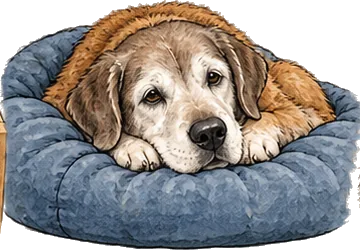
A dog becomes a senior when it enters the last quarter of its expected lifespan1. Small dogs tend to outlive big ones, so that point lands anywhere from about 7 years for a giant breed to about 10 for a toy or small breed. The table below is our own conversion of that rule into ages.
When is a dog considered a senior?
The American Animal Hospital Association (AAHA) does not set one senior age for all dogs. Its 2019 life stage guidelines define the senior stage as the final 25% of estimated lifespan, running through end of life, and leave the estimate to the vet team based on breed and size1. The same guidelines set the start of adulthood, which our guide to when dogs stop growing covers. AAHA's 2023 Senior Care Guidelines kept that same definition2.
To put numbers on it, you need life expectancy by size. A 2023 study of millions of dogs seen at US Banfield clinics calculated life expectancy at birth for purebred dogs in five weight groups3. The study does not name a senior age. We took 75% of each life expectancy to estimate when the senior stage starts for a typical dog of that size.
| Size group (adult weight) | Life expectancy at birth | Senior from about (our calculation) |
|---|---|---|
| Toy (under 12 lb) | 13.4 years | 10 years |
| Small (12 to 24 lb) | 13.5 years | 10 years |
| Medium (24 to 57 lb) | 12.7 years | 9.5 years |
| Large (57 to 99 lb) | 11.5 years | 8.5 years |
| Giant (99 lb and up) | 9.5 years | 7 years |
| Mixed breed (all sizes) | 12.7 years | 9.5 years |
The study grouped breeds by their average adult weight using kilogram cutoffs (5.5, 11, 26 and 45 kg), converted to pounds here3. Mixed-breed dogs were not split by size, so for a mix we suggest using the row that matches its adult weight. These size bands are not the same as the ones in our dog age calculator, which follows the AAHA age chart and splits dogs at 20, 50 and 90 lb. A 22 lb dog, for example, is small in this table but medium in the calculator.
Why breed can move the number by years
Size explains a lot, but not everything. The Royal Veterinary College's VetCompass life tables, built from 30,563 UK dogs that died between 2016 and 2020, put average life expectancy at 11.2 years4. Jack Russell Terriers topped the list at 12.7 years and Border Collies came in at 12.1. Flat-faced breeds sat at the bottom: Pugs at 7.7 years, English Bulldogs at 7.4 and French Bulldogs at 4.54.
Apply the 75% rule to those figures and a Jack Russell turns senior around 9.5, a Border Collie around 9, and a Pug or English Bulldog closer to 5.5 or 6. Females and neutered dogs also lived somewhat longer than males and intact dogs in the UK data4. If you want to check where your breed falls by weight, its page in our breed directory lists the typical adult range.
How to work out your own dog's senior age
- Find your dog's adult weight. If your dog is carrying extra pounds, use the weight your vet would call ideal.
- Match that weight to a row in the table above.
- Adjust for breed. A breed known to be long-lived for its size can push the start later, and a flat-faced or giant breed pulls it earlier.
- Multiply your best lifespan estimate by 0.75. That's the age to start senior screening.
- Run your dog through the dog age calculator to see the human-equivalent age for its size, then confirm the plan at your next checkup.
Worked example: a 70-pound Labrador mix is in the large group, with a life expectancy of 11.5 years. Multiplying 11.5 by 0.75 gives 8.6, so this dog crosses into the senior stage at about 8 and a half. A 10-pound Shih Tzu mix in the toy group gets 13.4 times 0.75, which is 10.0 years.
Normal aging or a sign of illness?
AAHA warns that owners often read changes in an older pet as normal aging when chronic pain or disease is behind them, and asks vets not to let "old age" stand in for a diagnosis2. Slowing down a little is expected. A change that is new, getting worse or affecting daily life deserves an exam.
| What you notice | Fits gradual aging | Book a vet visit |
|---|---|---|
| Sleep | Naps a bit more during the day | Sleeps all day and paces, whines or barks at night |
| Movement | Shorter walks, slower on stairs | Limping, trouble rising, won't jump into the car anymore |
| Weight | Gains slowly on the same food | Loses weight or muscle without a diet change |
| Thirst and urine | No change | Drinks more, pees more, or has accidents indoors |
| Behavior | Calmer, less interest in rough play | Gets stuck in corners, seems lost, ignores family |
| Appetite | Steady | Picky, slow to eat, or chewing on one side |
Changes in appetite, thirst or weight can point to chronic disease, and stiffness or reluctance to jump can be early arthritis, per the 2023 guidelines2. A short phone video of your dog getting up or climbing stairs helps the vet see what happens at home; AAHA specifically recommends this for pain assessment2.
How often should a senior dog see the vet?
AAHA recommends a senior workup once or twice a year2. Cornell's Riney Canine Health Center goes further and suggests an exam at least every six months for older dogs, with quick checks at home between visits5.
| Screening test | Suggested frequency for senior dogs | What it can catch |
|---|---|---|
| Complete blood count (CBC) | Every 6 to 12 months | Anemia, infection, some cancers |
| Chemistry panel | Every 6 to 12 months | Kidney and liver changes, diabetes |
| Urinalysis | Every 6 to 12 months | Kidney function, urinary infection |
| Thyroid (T4) | Yearly | Hypothyroidism |
| Blood pressure | Yearly | Hypertension |
| Fecal test | 1 to 4 times a year | Intestinal parasites |
| Heartworm and tick-borne disease | Yearly | Infections spread by mosquitoes and ticks |
| ECG | Yearly in high-risk breeds such as Boxers and Dobermans | Heart rhythm problems |
The schedule above comes from the screening table in the 2023 guidelines2. That document also mentions newer blood markers such as SDMA for kidney function and NT-proBNP for heart disease, with NT-proBNP worth checking before anesthesia2. A first full panel while your dog is healthy gives your vet a baseline, so later shifts stand out.
Diet and weight changes for an older dog
Most dogs need fewer calories as they age. AAHA notes that maintenance energy needs generally fall over a dog's lifetime, and that senior dogs do better on food with lower calorie density and more fiber, often with a modest bump in protein quantity and quality2. The target body condition score for a senior dog is 4.5 to 5 on the 9-point scale2. You can check your dog against that scale with our guide to body condition.
Lean dogs tend to age better. In the Purina-funded Labrador lifetime study reported by the University of Pennsylvania, dogs fed 25% fewer calories than their littermates lived a median of 13 years versus 11.2 for the heavier group6. At age 10, 42% of the lean dogs had hip osteoarthritis compared with 79% of the heavier ones6.
Here's the math for an older dog that needs to slim down. Take a neutered Labrador at 70 lb whose vet sets a goal of 62 lb, or 28.1 kg. Resting energy is 70 × 28.10.75, about 855 calories. The weight-loss factor is 1.0 at goal weight, so the daily target is roughly 855 calories, with treats under 86 of them. Our dog food calculator does this arithmetic and converts it into cups for your food's calorie content.
Unexplained weight loss in an older dog is a different story. Don't fix it by feeding more before a vet has looked for a cause, since kidney disease, dental pain and cancer can all show up this way.
Exercise and arthritis
Arthritis is a frequent reason older dogs slow down. Signs listed by the Merck Veterinary Manual include lameness, swollen joints and muscle wasting, and its treatment advice includes weight loss when needed and exercise on soft surfaces7. Anti-inflammatory drugs (NSAIDs) relieve pain, though long-term use can cause vomiting, poor appetite and gut inflammation7. Ask your vet how they plan to monitor a dog on them long term.
AAHA recommends treating senior pain with several approaches at once: medication, weight control, rehabilitation, acupuncture and changes to the home2. A few practical shifts:
- Swap one long walk for two or three shorter ones.
- Choose grass, dirt trails or a rubber track over pavement when you can.
- Skip repeated ball-chasing with sudden stops and twists.
- Ask about swimming or an underwater treadmill, which Cornell lists among the rehab options that keep older dogs active5.
Canine cognitive dysfunction
Dogs can develop an age-related decline in thinking and memory similar to dementia. The 2023 guidelines put it at 14% to 22.5% of dogs older than 82. Vets screen for it with the DISHAA checklist5:
- Disorientation: getting stuck behind furniture or in corners, staring at walls.
- Interactions: less interest in family, or new irritability.
- Sleep-wake changes: sleeping by day, restless at night.
- House soiling: accidents in a dog that was reliably trained.
- Activity: aimless pacing, or much less activity.
- Anxiety: new fear of being alone, of strangers or of new places.
Night restlessness is often the first sign families pick up on, according to Cornell5. Treatment works better when started early2. AAHA describes selegiline as the only drug labeled for canine cognitive dysfunction and says it helps up to 70% of affected dogs2. Some owners see a change within three weeks, but many dogs take about six, per Cornell5. Expect your vet to look for other problems, such as pain or vision loss, before settling on dementia.
Where owners of older dogs go wrong
- Waiting for a birthday. A Great Dane at 7 and a Chihuahua at 10 are at about the same life stage. Go by size and breed, not a single age.
- Calling every change "just old." Limping, thirst, weight loss and night pacing all have treatable causes.
- Keeping the young-adult food portion. Calorie needs drop, and a few extra pounds load sore joints.
- Stopping exercise entirely. Regular gentle movement helps a stiff dog keep its muscle. Shorter outings usually beat rest alone.
- Skipping blood work because the dog seems fine. Screening exists to find kidney, thyroid and blood pressure problems before they cause signs at home2.
- Rearranging the house. A dog with failing sight or memory relies on furniture and bowls staying put.
Home adjustments that help a senior dog
Small changes at home can cut down on slips and confusion. Most of these come from the AAHA guidelines and Cornell's advice for dogs with cognitive decline25:
- Lay rugs, runners or yoga mats over slick floors, especially near the food bowl and the door.
- Add a ramp to the car, bed or couch, and gate off stairs.
- Raise food and water bowls for a dog with a stiff neck or back.
- Put a thick, supportive bed somewhere easy to reach.
- Use nightlights in hallways for dogs with poor vision or nighttime confusion.
- Keep a set routine for meals, walks and bedtime, with an extra short walk before bed.
- For large dogs that struggle to stand, keep a support harness or sling by the door.
- For a dog losing its hearing, stamp the floor as you approach so it feels you coming.
- Check that the microchip and ID tag details are current, since a confused dog can wander off.
Common questions
At what age is a dog considered a senior?
It depends on size. AAHA defines senior as the last 25% of expected lifespan. Applying that to US clinic data on life expectancy, our calculation gives about 10 years for toy and small dogs, 9.5 for medium dogs, 8.5 for large dogs and 7 for giant breeds. Short-lived breeds such as Bulldogs and Pugs can reach it earlier.
Is a 7-year-old dog a senior?
A 7-year-old giant breed such as a Great Dane or Mastiff usually is, since giant dogs average about 9.5 years of life. A 7-year-old Labrador is a mature adult nearing the senior stage, which by our estimate starts around 8.5 for large dogs. A 7-year-old small dog has roughly three more years before it counts as a senior.
How often should a senior dog go to the vet?
AAHA recommends a senior workup once or twice a year, and Cornell's canine health center suggests at least every six months. Blood count, chemistry panel and urinalysis are advised every 6 to 12 months, with thyroid and blood pressure checks yearly. Call sooner for weight loss, more drinking, limping or night pacing.
Should I switch my dog to senior dog food?
Not every older dog needs a senior-labeled food, but most need fewer calories than they did as young adults. AAHA suggests lower calorie density, more fiber and good-quality protein for senior dogs, with a body condition score of 4.5 to 5 out of 9. Ask your vet before switching if your dog has kidney, liver or heart disease.
What are the first signs of dementia in dogs?
Changes in the sleep cycle are often the first thing families notice: sleeping through the day and pacing, whining or barking at night. Other signs include getting stuck in corners, ignoring family, new house-soiling and anxiety. These overlap with pain, vision loss and urinary problems, so a vet exam comes before any treatment.
See Orthopedic dog beds on Amazon. As an Amazon Associate we earn from qualifying purchases.
 Sources
- American Animal Hospital Association, Canine life stage definitions (2019 AAHA Canine Life Stage Guidelines), 2019
- Dhaliwal R, Boynton E, Carrera-Justiz S, et al., 2023 AAHA Senior Care Guidelines for Dogs and Cats, Journal of the American Animal Hospital Association, 2023
- Montoya M, Morrison JA, Arrignon F, Spofford N, Charles H, Hours MA, Biourge V, Life expectancy tables for dogs and cats derived from clinical data, Frontiers in Veterinary Science, 2023
- Royal Veterinary College VetCompass, New RVC research helps owners better understand the remaining life expectancy of dogs (on Teng KT et al., Life tables of annual life expectancy and mortality for companion dogs in the United Kingdom, Scientific Reports, 2022)
- Cornell University Richard P. Riney Canine Health Center, Senior dog dementia
- Penn Today (University of Pennsylvania), Study finds dogs fed reduced-calorie diet live nearly two years longer, 2002 (on Kealy RD et al., Journal of the American Veterinary Medical Association, 2002)
- Merck Veterinary Manual, Pet Owner Version, Osteoarthritis (Degenerative Joint Disease) in Dogs
General information, not veterinary advice. If your pet is unwell, call your vet.
