
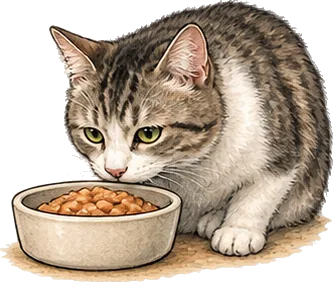
A typical spayed or neutered indoor cat needs about 25 to 30 calories per pound of body weight a day, which works out to roughly 260 to 300 calories for a 10 lb cat. That number comes from the formula vets use, and it is only a starting point. The amount in cups or cans depends entirely on the calorie count printed on your food's label, and even among diet foods, one kibble can carry 200 more calories per cup than another.3
The formula behind the numbers
Vets start with resting energy requirement (RER), the calories a cat burns lying still in a comfortable room. The 2021 AAHA nutrition guidelines give it as RER = 70 × (body weight in kg)0.75.1 To convert pounds to kilograms, divide by 2.2. That result then gets multiplied by a life-stage factor to give daily calories:10
- Kitten, still growing: 2.5 × RER
- Spayed or neutered adult: 1.2 to 1.4 × RER
- Intact adult: 1.4 to 1.6 × RER
- Inactive or prone to gaining weight: 1.0 × RER
- Weight loss: 0.8 × RER, calculated at the goal weight, not the current one
For a neutered indoor cat that spends most of the day asleep, the 1.2 end of that range is the safer place to start. Our cat food calculator runs this math for you, and the methods page explains where each factor comes from.
Daily calories by weight
These figures use the same formula and rounding as the calculator. Treat them as a first estimate. Individual cats can need noticeably more or less, and the scale is what tells you which camp yours is in.
| Cat's weight | Resting (RER) | Neutered adult (1.2-1.4) | Intact adult (1.4-1.6) |
|---|---|---|---|
| 6 lb | 150 | 180-210 | 210-240 |
| 8 lb | 180 | 220-260 | 260-290 |
| 10 lb | 220 | 260-300 | 300-350 |
| 12 lb | 250 | 300-350 | 350-400 |
| 14 lb | 280 | 340-390 | 390-450 |
| 16 lb | 310 | 370-430 | 430-500 |
A heavy cat should not be fed from the row matching its current weight. Take a 16 lb cat whose ideal weight is 12 lb: it gets planned from the 12 lb row, or from the weight-loss method further down. For kittens, the 2.5 growth factor applies while they are still growing, and our calculator suggests a growth food until about one year; the kitten weight chart shows whether growth is on track, and our week-by-week kitten care guide covers feeding changes in the first months.
Wet vs dry food: calories per can and per cup
Calorie density is where most portion errors start. Dry food holds 6 to 10 percent water, while canned food is at least 75 percent water.4 Water carries no calories, so a cup of kibble packs several times the energy of a cup of paté. Even within one category the spread is wide. A Tufts study of foods sold for weight control found dry cat foods ranging from 235 to 480 calories per cup, and canned foods from 78 to 172 calories per can.3
| Dry food | Wet (canned) food | |
|---|---|---|
| Water content | 6-10% | 75% or more |
| Calories, weight-control formulas | 235-480 per cup (median 342) | 78-172 per can (median 146) |
| How to measure | Kitchen scale in grams; cups are imprecise | Fraction of a can or pouch |
| Label figure to look for | kcal/cup and kcal/kg | kcal/can and kcal/kg |
The practical rule: find the “kcal/cup” or “kcal/can” line on the bag or can, then divide your cat's daily calories by it. A 10 lb neutered cat at 260 calories eating a 360 kcal/cup kibble needs about 0.72 cup a day. That same cat on a 90-calorie 3 oz can would need almost three cans. The AAFP feeding statement recommends weighing food with a kitchen scale when possible, because scooping with a measuring cup is inexact.5 For a scale, use the kcal/kg figure: 3,600 kcal/kg means 3.6 calories per gram.
Mixing wet and dry
Plenty of cats eat both. Budget the calories first and split them second. Decide how much wet food the cat gets, subtract its calories from the daily total, and fill the remainder with dry food. Treats come off the top as well. AAHA caps treats and other extras at 10 percent of daily calories, about 26 calories for a cat eating 260.2
How many meals, and how to serve them
Cats are solitary hunters, and they prefer to eat alone in small, frequent portions.5 The 2018 consensus statement from the American Association of Feline Practitioners (AAFP) and the International Society of Feline Medicine advises splitting the daily allowance into several small meals spread over 24 hours, using puzzle feeders where possible.5 Many households feed twice a day. Adding even one or two extra small portions moves the routine closer to how cats prefer to eat.
Options, from simplest to most involved:
- Measured meals: weigh the day's food each morning and divide it into portions. Anything left in the container at bedtime is the last serving.
- Timed automatic feeder: handy for a midday meal, though the AAFP notes these usually do nothing to encourage foraging.5
- Puzzle feeders and hidden food: the consensus statement links them to more activity, mental stimulation, and support for weight control. Start with a simple design so the cat succeeds early, then move to harder ones.5
- Scattered portions: placing small amounts in new spots, including shelves and cat trees, turns a meal into a short hunt.5
In homes with more than one cat, give each cat its own feeding station, out of sight of the others and away from litter boxes.5 Microchip-activated feeders, also mentioned in the statement, stop one cat from eating another's diet food.5
How common are overweight cats?
More common than lean ones. In the 2022 clinic survey by the Association for Pet Obesity Prevention, veterinarians scored 61 percent of cats as overweight or obese: 28 percent overweight and 33 percent obese, against 38 percent at an ideal body condition.6 Owners tended to miss it. Among owners whose cats were scored overweight or obese, 28 percent described the cat's body as normal.6 Long coats and the loose belly flap many cats carry can make the eye test harder. Vets use a 9-point body condition score, the same scale described in our dog body condition guide, and scores of 6 to 9 fall in the overweight and obese groups.6 A cat in that range is worth a conversation about a goal weight.
How fast a cat can safely lose weight
Slowly. The AAHA weight management guidelines set the target rate for cats at 0.5 to 2 percent of body weight per week, slightly gentler than the 1 to 2 percent set for dogs.7 For a 14 lb cat, that is roughly 1 to 4.5 ounces a week. Those guidelines also suggest a check-in by phone or visit every 2 weeks, with monthly monitoring until the cat reaches its ideal weight.7
Why crash diets are dangerous for cats
Cats that eat too little can develop hepatic lipidosis, or fatty liver. When intake drops, the body sends stored fat to the liver faster than the liver can process it, and liver function fails.9 Cornell's Feline Health Center notes that the disease seems far more common in obese cats and that a loss of appetite almost always comes before or along with it.9 According to the Merck Veterinary Manual, affected cats have usually lost more than 25 percent of their weight, and even with intensive care survival is around 75 to 80 percent in severe cases.8 AAHA warns that cutting calories below 60 percent of RER may raise this risk in cats.7 In practice that means never halving a cat's food overnight, never switching to a food the cat refuses, and calling your vet if an overweight cat stops eating for a day or more.
Step by step: setting up a feeding plan
- Weigh the cat. A baby scale is most accurate; otherwise weigh yourself holding the cat and subtract your own weight.
- Ask your vet for a body condition score and, if needed, a goal weight.
- Calculate daily calories with the formula above or the calculator, using goal weight and the 0.8 factor if the cat needs to lose weight.
- Subtract up to 10 percent for treats.
- Convert the rest to grams, cups, or cans using the label's calorie line.
- Divide the day's food into at least two meals, ideally more, with some served in a puzzle feeder.
- Weigh the cat every 2 weeks. If weight is drifting the wrong way, change the daily amount by about 10 percent and check again.
Feeding errors that throw the numbers off
- Trusting the bag's feeding chart. In the Tufts study, the label directions on weight-loss cat foods ranged from 0.67 to 1.55 times RER.3 At the top end that is more food than a neutered cat at a healthy weight needs.
- Calculating from current weight for a heavy cat. Feeding a 16 lb cat for 16 lb holds it at 16 lb.
- Leaving a full bowl down. The AAFP statement notes that cats are often fed large meals or free choice, and it links large portions to overeating and obesity.5 If you prefer it, fill the bowl with only the day's measured amount.
- Forgetting the extras. Lickable treats, dental treats, and bites of chicken all count toward the 10 percent.
- Switching foods without redoing the math. A new food at 480 kcal/cup fed in the same scoop as the old 340 kcal/cup food adds about 40 percent more calories.
Worked example: a 14 lb cat with a vet-set goal of 11 lb
Milo is a neutered indoor cat weighing 14 lb. His vet scores him overweight and sets 11 lb as his goal.
Resting calories at goal weight. 11 lb ÷ 2.2 = 5.0 kg. 5.00.75 is about 3.34, and 70 × 3.34 = about 234 calories.
Weight-loss target. 234 × 0.8 = 187, rounded to 190 calories a day.
Safety check. RER at his current 14 lb is about 280, and 60 percent of that is 168. His 190-calorie plan stays above that floor.
Treat budget. 10 percent of 190 is 19 calories, so a few small treats at most.
Turning it into food. Say Milo gets one 3 oz can of wet food labeled 80 kcal/can, plus kibble labeled 3,600 kcal/kg. After the wet food and a 15-calorie treat allowance, 95 calories remain for kibble. At 3.6 calories per gram, that is about 26 g of dry food. Half the can goes down in the morning, half at dinner, and the 26 g of kibble is split between a puzzle feeder at midday and a few scattered portions in the evening.
Expected pace. At 1 percent a week, Milo should lose about 2 ounces in the first week. Losing 3 lb at that rate takes around 24 weeks. If his biweekly weigh-in shows no change after a month, his vet may trim the plan by about 10 percent. Faster loss than 2 percent a week, or any skipped meals, is a reason to call the vet. Once he reaches 11 lb, his maintenance target moves up to the neutered range for that weight, about 280 to 330 calories, and you can check it any time on the cat food calculator.
Common questions
How many calories should an indoor cat eat a day?
A spayed or neutered indoor cat usually needs 1.2 to 1.4 times its resting energy requirement, per the 2021 AAHA guidelines. That is about 220 to 260 calories for an 8 lb cat and 260 to 300 for a 10 lb cat. Very inactive cats may need closer to 1.0 times RER. Weigh your cat every couple of weeks and adjust the amount by about 10 percent if weight changes.
How many cans of wet food should a cat eat a day?
Divide your cat's daily calories by the kcal per can on the label. A 10 lb neutered cat needing 260 calories would eat about three 90-calorie 3 oz cans, or a little under two 150-calorie 5.5 oz cans. Can sizes and recipes vary widely, so always use the number printed on the can you are feeding.
How much dry food should I feed my cat in cups?
Divide daily calories by the kcal per cup on the bag. A 10 lb neutered cat eating a 360 kcal/cup food needs about three-quarters of a cup a day. Because cups are imprecise and dry foods range from roughly 235 to 480 kcal per cup, a kitchen scale and the label's kcal/kg figure give a more reliable portion.
Is it OK to leave dry food out all day for my cat?
The 2018 AAFP feeding consensus statement links large portions with overeating and obesity, and it recommends several measured small meals, ideally with puzzle feeders. If your cat is used to grazing, you can keep a bowl down but fill it once a day with only the measured daily amount, so the cat cannot eat more than its calories.
How much weight can a cat safely lose per week?
AAHA weight management guidelines set the target at 0.5 to 2 percent of body weight per week for cats. For a 12 lb cat, that is about 1 to 4 ounces a week. Faster loss, or a cat that stops eating, raises the risk of hepatic lipidosis (fatty liver), so call your vet if either happens.
Should I feed my overweight cat for its current weight or its ideal weight?
Use the ideal weight your vet sets. The AAHA weight-loss method multiplies the resting energy requirement at goal weight by 0.8. Feeding for the current weight keeps a heavy cat at that weight. Keep the plan above 60 percent of resting calories at current weight, since AAHA notes deeper cuts may raise liver risk in cats.
See Cat puzzle feeders on Amazon. As an Amazon Associate we earn from qualifying purchases.
 Sources
- AAHA, 2021 AAHA Nutrition and Weight Management Guidelines for Dogs and Cats: Weight Reduction in the Obese Pet, 2021
- AAHA, 2021 AAHA Nutrition and Weight Management Guidelines for Dogs and Cats: Feeding Plans for Healthy, Appropriate Weight Cats and Dogs, 2021
- Linder DE, Freeman LM, Evaluation of calorie density and feeding directions for commercially available diets designed for weight loss in dogs and cats, Journal of the American Veterinary Medical Association, 2010
- Cornell Feline Health Center, Feeding Your Cat
- Sadek T, Hamper B, Horwitz D, Rodan I, Rowe E, Sundahl E, Feline feeding programs: addressing behavioural needs to improve feline health and wellbeing (AAFP/ISFM consensus statement), Journal of Feline Medicine and Surgery, 2018
- Association for Pet Obesity Prevention, 2022 State of U.S. Pet Obesity Report, 2022
- AAHA, 2014 AAHA Weight Management Guidelines for Dogs and Cats: Monitoring and Maintenance, 2014
- Center SA, Merck Veterinary Manual, Feline Hepatic Lipidosis, reviewed 2023 (updated 2025)
- Cornell Feline Health Center, Hepatic Lipidosis
- AAHA, 2021 AAHA Nutrition and Weight Management Guidelines for Dogs and Cats, Box 1: Calculating energy requirements (life stage factors), 2021
General information, not veterinary advice. If your pet is unwell, call your vet.
