
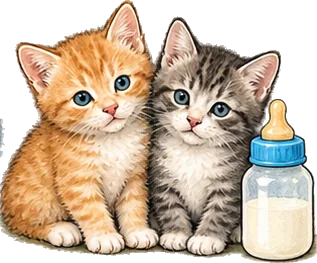
A newborn kitten weighs about 70 to 115 grams and should put on 7 to 15 grams every day for its first eight weeks.1 Most double their birth weight by two weeks.2 That daily gain is the single best health check you have, so buy a kitchen scale that reads in grams before you do anything else.
Kitten care week by week: the table
Weights for weeks 1 to 8 are the ASPCA ranges for the last day of each week.1 Feeding counts are milk feedings from the ASPCA foster schedule,3 and nest temperatures come from Maddie's Fund.2 With a healthy mother present, your jobs are weighing, watching and vet visits.
| Age | Weight by end of week | Milk feedings a day | Nest temperature | What's happening, what to do |
|---|---|---|---|---|
| Week 1 (days 1-7) | 142-190 g (5-6.7 oz) | 8-12, every 2-3 hours | 85-90°F | Umbilical stump drops off at 2-4 days. Eyes and ears closed. Stimulate to pee and poop at every feeding. |
| Week 2 | 191-295 g (6.7-10.4 oz) | 8-12, every 2-3 hours | 79-84°F | Eyes open between days 5 and 14, ears between days 6 and 17. Ask your vet about the first deworming. |
| Week 3 | 240-400 g (8.5-14 oz) | 8-12, every 2-4 hours | 79-84°F | Walking by about day 16, steadier gait by day 21. Baby incisors come in. Start short daily handling. |
| Week 4 | 289-505 g (10-17.8 oz) | 5-6, every 4-5 hours | 73.5-79°F | Can now hold body heat. Starts peeing alone. Litter box out if not already, plus a first saucer of slurry. |
| Week 5 | 338-610 g (12-21.5 oz) | 3-4, every 5-6 hours | Room temp plus a warm spot | Thicken the slurry. Play, climbing and pouncing pick up. |
| Week 6 | 387-715 g (13.7-25.2 oz) | 3-4, every 6 hours | Room temp | Eye color changing from baby blue. First vet visit and first core vaccine (no earlier than 6 weeks). |
| Week 7 | 436-820 g (15.4-28.9 oz) | 2-3, every 8 hours | Room temp | Solid food makes up more of each day. Main socialization window is closing. |
| Week 8 | 485-925 g (1.1-2.0 lb) | 2-3, or weaned | Room temp | Eating dry food. FeLV vaccine can start. Monthly parasite preventive can begin. |
| Weeks 9-12 | Typical 1.0 kg at 9 weeks to 1.4-1.5 kg (3.1-3.3 lb) at 12 weeks | None; kitten food only | Room temp | Core vaccine every 3-4 weeks, second FeLV dose. Week 12 is a good age to go to a new home. |
Milestones come from Maddie's Fund and the ASPCA;23 parasite and vaccine timing from AAHA/AAFP.45 The 9 to 12 week weights are typical (median) values from our analysis of Salt et al. (2022), which built growth charts from vet-clinic weigh-ins of intact domestic shorthair kittens in ideal body condition.6 You can see how we did it on our methods page.
How much a kitten should weigh each week
One weigh-in tells you less than the trend, so weigh daily before a feeding and log it. Plug the number into our kitten weight chart, which uses the ASPCA figures up to 8 weeks and the Salt data after that. After 8 weeks, males start to pull ahead: in the data the chart uses, a typical male is about 1.50 kg at 12 weeks and a typical female about 1.41 kg.6
Example: a kitten weighs 180 g on day 14 and 210 g on day 21. That is 30 g in 7 days, or 30 ÷ 7 = 4.3 g a day, below the 7 to 15 g normal range.1 At 210 g on day 21 it also sits under the ASPCA low end of 240 g. Together those numbers mean a call to the vet that day.
A newborn that drops more than 10% of its birth weight in the first 24 hours needs supplemental feeding, according to a 2022 review on fading kittens.7
Bottle feeding a kitten: how much and how often
Orphaned kittens need commercial kitten milk replacer; vets prefer it over homemade recipes.7 Maddie's Fund puts daily needs at about 20 to 26 calories per 100 g of body weight, and a kitten's stomach holds roughly 4 ml per 100 g.2 Their feeding table uses the low end, 20 calories per 100 g; by our arithmetic its daily volumes come to about 27 ml of formula for every 100 g the kitten weighs, split across 7 feedings up to about 275 g, then fewer, larger meals as it grows.2
Worked example: a 2-week-old kitten weighs 250 g. Daily formula is 250 × 0.27 = about 68 ml. Spread over 7 feedings, that is 68 ÷ 7 = about 9.7 ml per feeding, which fits under its stomach capacity of 250 × 0.04 = 10 ml. Recalculate every few days, because a 400 g kitten, typically 3 to 4 weeks old, needs about 108 ml a day.2
Step by step at each feeding
- Check the kitten is warm. If it feels cool, warm it first and hold off on feeding until its temperature is back above about 96.8°F (36°C).7
- Warm the formula to about 97 to 100°F and test a few drops on your wrist.2 Mixed formula keeps in the fridge for 24 hours.8
- Set the kitten on its belly on a towel, never on its back, so formula can't go down the windpipe.8
- Tip the bottle so milk drips at 1 to 2 drops a second and let the kitten suck at its own pace.2 A session usually takes 5 to 10 minutes.8
- Stimulate it to pee and poop with a warm, damp cotton ball, rubbing gently front to back.8
- Log the time, the amount taken, and whether it peed and pooped.
Keeping newborn kittens warm
Kittens can't control their own body temperature until about 4 weeks old.3 Normal rectal temperature is 95 to 99°F in the first two weeks, 97 to 100°F at 2 to 4 weeks, and 100 to 101.5°F after that. Anything below 95°F is abnormal.2 Rewarm a chilled kitten slowly, about 2°F an hour, against your skin or on a wrapped heat source.2
Wrap any heating pad or hot water bottle in a towel so paw pads don't burn,8 and cover only part of the box floor. Leaving an unheated area lets a kitten crawl away if it gets too hot.7
Toileting and litter training
Until 3 to 4 weeks, kittens can't eliminate without help.2 Stimulate before and after every feeding. The ASPCA tells its fosters to report a kitten that hasn't peed in 12 hours or two feedings, or hasn't pooped in 2 days; at home, that is a call to your vet.8
Put out a shallow box, such as a baking tray, at about 3 weeks, when kittens start to go on their own.3 Many fosters use unscented, non-clumping litter or shredded paper at first, because young kittens may eat what they dig in. Set the kitten in the box right after meals and naps. Leaving a little of its own scent in the box helps it find the spot again.
Weaning from 4 weeks
Interest in solid food usually shows up at 3 to 4 weeks.2 Start with canned kitten food thinned with formula into a slurry on a flat saucer, then make it thicker over the next couple of weeks while you cut bottle feedings, following the frequency column in the table.3 By 8 weeks most kittens eat dry food.2 Once a kitten is fully on solid food, our cat food calculator uses the AAHA growth factor of 2.5 times resting energy. A 1.4 kg kitten at 12 weeks has a resting need of 70 × 1.40.75 = about 90 calories, so it needs about 90 × 2.5 = 225 calories a day (the calculator rounds this to 230). The guide on how much to feed a cat covers turning that into cans and cups.
First vet visit, deworming and vaccines
Under the AAHA/AAFP life stage guidelines, roundworm treatment every 2 weeks can start at 3 weeks of age,4 and the ASPCA's foster program starts at 2 weeks.3 A monthly parasite preventive can begin at 8 to 9 weeks, and fecal tests help your vet confirm it is working, so bring a fresh stool sample if asked.4
For a healthy kitten with its mother, a first visit around 6 weeks matches the earliest age for the core vaccine. See an orphan or any kitten with a red flag sooner. Under the 2020 AAHA/AAFP guidelines for pet cats:5
- Panleukopenia, herpesvirus and calicivirus (FVRCP): no earlier than 6 weeks, then every 3 to 4 weeks until 16 to 20 weeks. The guidelines suggest considering a booster at 6 months rather than waiting until 1 year.
- Feline leukemia (FeLV): core for cats under 1 year. After a FeLV test, two doses 3 to 4 weeks apart, starting as early as 8 weeks, then a booster 12 months after the last dose.
- Rabies: timing follows the vaccine label and your local law.
As one example only, a kitten adopted at 8 weeks might get FVRCP at 8, 11, 14 and 17 weeks plus a 6-month booster, with FeLV at 8 and 11 weeks. Your vet will set the exact dates. Spay or neuter timing is a separate decision covered in when to spay or neuter.
The socialization window
Classic research puts the kitten socialization period at about 2 to 7 weeks.9 ASPCA foster materials use a wider 4 to 12 weeks.3 In Karsh's work, raising daily handling from 15 to 40 minutes made kittens spend more time close to people at 14 weeks. An earlier study by Collard found that kittens handled by five people tried to escape from a stranger less often than kittens handled by one.9
From week 2 or 3, pick each kitten up for a few minutes several times a day. Add new people, gentle paw and ear handling, and an open carrier with a towel in it.
When kittens can leave their mother
Eight weeks is the floor. In a University of Helsinki survey of nearly 6,000 cats, kittens weaned before 8 weeks showed more aggression and repetitive behavior as adults, and cats weaned at 14 weeks had fewer behavior problems than those weaned earlier. Finland already recommends at least 12 weeks.10 Expecting a litter at home? The cat pregnancy calculator gives the due date, so you can plan a 12-week rehoming date from day one.
Mistakes that hurt young kittens
- Feeding a cold kitten. A chilled kitten often won't suck, and feeding by mouth should wait until it is warm again.87
- Skipping the scale. A kitten can look fine and still be losing weight, and a daily weigh-in shows it before your eyes do.
- Overstimulating. Stop once the kitten has gone. Rubbing too long chafes the skin.8
- Rehoming at 6 weeks. Kittens weaned before 8 weeks showed more aggression as adults in the Finnish survey.10
Red flags and fading kitten syndrome
"Fading kitten" describes a kitten born apparently healthy that gradually weakens, usually in the first 2 weeks of life. Deaths cluster in the newborn period, with a second peak around weaning, when antibodies from the mother wear off and viral infections become more common.7 Call a vet or emergency clinic now if a kitten shows any of these:2
- Weight loss, or a kitten that stops gaining
- Limp, unresponsive, or not interested in the bottle
- Body temperature under 95°F or over 101°F, or feels cool to the touch
- Pale or white gums, or dry, tacky gums
- Crying that won't stop, or a tight, swollen belly
- Diarrhea, vomiting, or labored breathing
- Eye or ear swelling or discharge
While you get to the vet, keep the kitten warm against your body and bring your weight and feeding log. Don't force formula into a cold or limp kitten.7
Common questions
How much should a kitten gain each day?
A healthy kitten gains about 7 to 15 grams (roughly a quarter to half an ounce) a day for the first eight weeks, and most double their birth weight by two weeks old. Weigh at the same time each day on a gram scale. A kitten that loses weight or holds flat for a day or two needs a call to the vet, because young kittens have very little reserve.
Can I give a kitten cow's milk?
No. Use a commercial kitten milk replacer, which vets prefer over homemade recipes. Those products are modified to resemble a mother cat's milk, with more energy and less lactose than plain cow's milk. If you're stuck at night with no formula, call an emergency vet or a local rescue for advice and buy kitten formula as soon as a store opens.
When do kittens start eating wet food?
Most show interest in solid food at 3 to 4 weeks. Start with a thin slurry of canned kitten food mixed with formula on a flat saucer, then thicken it over one to two weeks. By about 8 weeks most kittens are eating solid kitten food, including dry, and no longer need a bottle.
What age can a kitten get its first shots?
Under the AAHA/AAFP guidelines, the combination vaccine for panleukopenia, herpesvirus and calicivirus starts no earlier than 6 weeks and repeats every 3 to 4 weeks until 16 to 20 weeks, with a booster often considered at 6 months. Feline leukemia vaccine can start at 8 weeks as two doses 3 to 4 weeks apart. Rabies timing follows the vaccine label and local law.
Is 8 weeks too early to bring a kitten home?
Eight weeks is the minimum, not the ideal. Kittens weaned before 8 weeks showed more aggression and repetitive behaviors in a survey of nearly 6,000 cats, and kittens weaned at 14 weeks had fewer problems. If you can, wait until 10 to 12 weeks, and pick a kitten that has been handled daily by several people.
See Kitten nursing bottles on Amazon. As an Amazon Associate we earn from qualifying purchases.
 Sources
- ASPCA, Kitten Age and Weight Chart, 2023
- Maddie's Fund, Practical Tips for Orphaned Kitten Care
- ASPCA, Early-Age Kitten and Puppy Foster Care (webinar slides)
- AAHA/AAFP, 2021 Feline Life Stage Guidelines: Parasites, 2021
- AAHA/AAFP, 2020 Feline Vaccination Guidelines: Core Vaccines for Pet Cats, 2020
- Salt C, German AJ, Henzel KS, Butterwick RF, Growth standard charts for monitoring bodyweight in intact domestic shorthair kittens from the USA, PLOS ONE, 2022
- Münnich A, Fading kitten syndrome: factors predisposing to 'faders' and treatment options, Journal of Feline Medicine and Surgery 24(3):243-256, 2022
- ASPCA, Kitten Bottle Feeding Guide, 2023
- Casey RA, Bradshaw JWS, The effects of additional socialisation for kittens in a rescue centre on their behaviour and suitability as a pet, Applied Animal Behaviour Science 114:196-205, 2008
- University of Helsinki, Delayed weaning reduces behavioural problems in cats (on Ahola MK, Vapalahti K, Lohi H, Early weaning increases aggression and stereotypic behaviour in cats, Scientific Reports), 2017
General information, not veterinary advice. If your pet is unwell, call your vet.
