
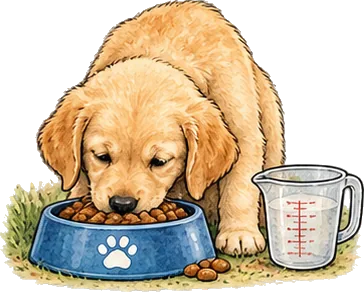
A puppy's food amount comes from two numbers: what the puppy weighs today and how old it is. Age sets the multiplier, weight sets the base, and the calorie line on your food bag turns the result into cups. The chart below does that math for common weights, and the steps after it show how to fit it to your own puppy and your own food.
Puppy feeding chart by weight and age
These figures use the same formula as our dog food calculator. Resting energy is 70 × body weight in kg raised to the 0.75 power. Healthy puppies under 4 months need about 3 times that resting figure each day, and puppies over 4 months need about 2 times it.2 The cup columns assume a kibble with 400 kcal per cup, which sits in the middle of most dry puppy foods. If your bag lists a different number, use the calorie columns and divide by your own figure.
| Current weight | Under 4 months (kcal/day) | Cups/day at 400 kcal | 4 months to adult (kcal/day) | Cups/day at 400 kcal |
|---|---|---|---|---|
| 2 lb | 195 | ½ | 130 | ⅓ |
| 5 lb | 388 | 1 | 259 | ⅝ |
| 10 lb | 653 | 1⅝ | 435 | 1⅛ |
| 20 lb | 1,098 | 2¾ | 732 | 1⅞ |
| 30 lb | 1,488 | 3¾ | 992 | 2½ |
| 40 lb | 1,846 | 4⅝ | 1,231 | 3 |
| 60 lb | 2,502 | 6¼ | 1,668 | 4¼ |
| 80 lb | 3,105 | 7¾ | 2,070 | 5¼ |
Read the row for the weight your puppy is now, not the weight you expect it to reach. A 10-pound Golden Retriever at 10 weeks eats for 10 pounds of body, and the portion climbs as the scale climbs. The jump from 3× to 2× at 4 months is a step in the formula; in real life the need tapers over several weeks, so expect to adjust in small amounts rather than cutting a third of the food overnight.
How many meals a day by age
Puppies from weaning to 6 months should eat three times a day, and puppies from 6 to 12 months can drop to two meals.1 Small-breed puppies may need more than three meals a day.1 Ask your vet how many if yours is a toy breed that is slow to finish or seems weak between meals.
| Age | Meals per day | Notes |
|---|---|---|
| 8 to 12 weeks | 3 (small breeds may need more) | Space meals evenly through the day |
| 3 to 6 months | 3 | Weigh weekly and adjust portions |
| 6 to 12 months | 2 | Calorie need per pound is falling |
| 12 months and up | 2 | Large breeds may still be on growth food |
Scheduled meals beat a bowl left out all day. Merck's finding that most dogs fed free choice get fat comes from adults,1 but its large-breed advice of weekly weigh-ins and portion tweaks is hard to follow when the bowl never empties.1 Set meals also show you right away when your puppy skips one. Pair the schedule with your crate training schedule so potty breaks follow each meal.
Work out your puppy's daily amount, step by step
- Weigh the puppy. Use a bathroom scale: weigh yourself holding the puppy, then subtract your own weight. Convert pounds to kilograms by dividing by 2.2046.
- Find resting energy. Multiply 70 by the weight in kg to the 0.75 power. Most phone calculators can do this with the xy key, or the calculator does it for you.
- Apply the age factor. Multiply by 3.0 if the puppy is under 4 months, or by 2.0 if it is 4 months or older.2
- Set aside treat calories. Treats, chews, and training rewards should stay at or under 10% of the day's calories.3 Take that 10% off before working out the kibble.
- Find the calorie line on your food. Under AAFCO's model rules, which states adopt, the label gives calories per kilogram and per familiar unit such as a cup or can, under a heading titled "Calorie Content."4
- Divide and split. Divide the food calories by kcal per cup, then split the total into the number of meals for your puppy's age.
- Weigh again in a week. Use the new weight to repeat the math and compare the trend to our puppy growth chart.
A kitchen scale gives more consistent portions than a scoop, which is easy to overfill. Labels list kcal per kilogram as well as per cup,4 so you can work in grams: divide kcal per kg by 1,000 to get kcal per gram.
Worked example: a Labrador at 12 weeks and at 6 months
Take a Lab puppy expected to reach about 80 pounds. At 12 weeks it weighs 20 pounds, and the food on hand lists 380 kcal per cup.
- 20 lb ÷ 2.2046 = 9.07 kg
- 9.070.75 = 5.23, and 70 × 5.23 = 366 kcal resting energy
- Under 4 months, so 366 × 3 = 1,098 kcal per day
- Treat budget: 10% is about 110 kcal, leaving 988 kcal for kibble
- 988 ÷ 380 = 2.6 cups per day, or a bit under 7/8 cup at each of three meals
At 6 months the same puppy weighs about 53 pounds (24.04 kg). Resting energy is 70 × 10.86 = 760 kcal, and the 4-months-plus factor gives 760 × 2 = 1,520 kcal. After a 10% treat allowance, that is 1,368 kcal, or 3.6 cups of the same food, now split into two meals of 1.8 cups.
The 53-pound figure is not a guess. In our analysis of US vet-clinic weigh-in data, a dog headed for 80 pounds had reached about 27% of adult weight at 12 weeks and 66% at 26 weeks (see our methods). Our adult size estimator runs that projection for any breed and age.
Large and giant breed puppies: calcium and growth speed
AAFCO treats a dog as large if it is expected to weigh 70 pounds or more as an adult.5 Some veterinary nutritionists argue a 50-pound cutoff is the safer line.6 For these puppies, the rules on calcium and growth rate matter more than for a Beagle or a Shih Tzu.
Calcium
Standard growth foods may contain 3 to 6.25 grams of calcium per 1,000 kcal. Foods that qualify for large-breed growth must stay between 3 and 4.5 grams per 1,000 kcal.5 The reason is that puppies from weaning to around 6 months may not limit how much calcium they absorb when the diet has too much,2 and a review of feeding trials concluded that dogs headed for about 30 kg (66 lb) or more as adults are the most vulnerable to excess calcium, with Great Danes among the dogs that developed severe signs in some studies.7
To check a bag, find the nutritional adequacy statement in the fine print. You want the phrase "including growth of large size dogs (70 lbs or more as an adult)." The phrase "except for growth of large size dogs" means the food is not meant for your puppy.5 Skip calcium, phosphorus, and vitamin D supplements when the puppy eats a complete growth diet; they are rarely needed and may do harm.1
Growth speed
For large breeds, slow growth is better than fast growth.1 Puppies typically gain 2 to 4 grams per day for each kilogram of expected adult weight during the first 5 months.1 By our arithmetic, an 80-pound (36 kg) adult target puts that at about 73 to 145 grams a day, or roughly 1.1 to 2.2 pounds a week. It is an average, so read steady gains well above it as a prompt to ask your vet about portions, not as a hard ceiling.
Holding a puppy lean does not stunt it. Feeding 50% to 70% of what littermates ate freely left height, length, and bone and muscle mass unchanged, and only body fat was lower.1 The AAHA guidelines likewise advise keeping giant-breed puppies at a lean body condition while avoiding excess calcium.3 Over a lifetime the payoff can be large: Labradors fed 25% less than their pair-mates from 8 weeks old lived significantly longer, and chronic disease showed up later.9
When to switch to adult food by size
Puppies should stay on a growth diet until skeletal maturity. That is about 1 year for small and medium dogs, while some large and giant breeds reach it closer to 15 or 16 months.3 Merck puts the end of growth at 8 to 12 months for small and medium breeds and 10 to 16 months for large and giant breeds, and notes that a less calorie-dense diet is usually advised once a dog reaches about 90% of its expected adult weight.1
| Expected adult weight | Reaches 90% of adult weight (our analysis) | Typical switch to adult food (published ranges) |
|---|---|---|
| Under 20 lb | About 42 weeks (10 months) | About 10 to 12 months1 |
| 20 to 50 lb | 42 to 43 weeks | About 12 months3 |
| 50 to 80 lb | 44 to 49 weeks | 12 to 16 months1 |
| Over 80 lb | About 51 weeks (12 months) | 12 to 18 months, often the later end3,10 |
Switching a big puppy to adult food at 6 months is a common shortcut, and it is not supported. Tufts nutritionists advise waiting until growth has stopped, around 12 to 18 months for large and giant dogs.10 When you do switch, mix the two foods for a few days instead of swapping all at once, and call your vet if loose stool lasts more than a day or two. Our guide on when dogs stop growing covers the size timelines in more detail.
Feeding errors that cause trouble
- Feeding for the adult weight. The bag's chart is often read against the dog's future size. Use today's weight and recalculate weekly.
- Trusting the bag over the dog. Label feeding tables cover a wide range of puppies. Treat them as a first guess and let body condition decide.
- Uncounted treats. Training sessions add up quickly. Count them inside the 10% limit,3 or use part of the meal kibble as rewards.
- Adding calcium to a large-breed diet. A complete growth food already has what the puppy needs, and extra calcium is the problem, not the fix.7
- Chasing a chunky puppy. A round puppy looks cute but is carrying fat its joints have to support. Aim for a visible waist.
- Sharing table scraps. Beyond the calories, some foods are dangerous. Check our list of foods toxic to dogs before handing anything over.
How to tell if the amount is right
Calories from a formula are an estimate. Body condition and the weekly weigh-in tell you whether the estimate fits your puppy. Weigh large-breed puppies every week and adjust so they gain a small amount each time.1
Vets score body condition on a 9-point scale, and 4 or 5 is ideal.8 Here is how to check at home:
- Ribs: At 4 to 5, you can feel the ribs easily with only a light fat cover. If you have to press to find them, the puppy is heading toward 6 or 7.8
- Waist from above: Look down at the puppy standing. An ideal dog shows a waist behind the ribs.8
- Belly from the side: The abdomen should tuck up toward the hind legs.8
- Too thin: Ribs you can see, plus hip bones starting to stick out, point to a score of 3 or lower.8
Puppies carry a little more softness than adults, so judge trends over two or three weeks. As a rule of thumb (not a formal guideline), a fading waist calls for trimming the daily amount by about 10% and rechecking in a week. When ribs start to show, add about the same. A score below 4 or above 5 should prompt a fuller nutrition review with your vet,3 and so should a puppy that stops gaining, leaves food for more than a day, or has ongoing diarrhea. For the full scoring method with photos, see is my dog overweight.
Common questions
How many cups should I feed my puppy?
It depends on the puppy's current weight, age, and the calories in your food. A 10-pound puppy under 4 months needs about 650 kcal a day, which is roughly 1⅝ cups of a 400 kcal/cup kibble. Find the kcal per cup on your bag's Calorie Content line, divide the daily calories by it, and recheck the amount every week as the puppy gains weight.
How many times a day should a puppy eat?
Feed three meals a day from weaning to 6 months, then two meals a day from 6 to 12 months. Merck notes that small-breed puppies may need more than three meals a day, so ask your vet if you have a toy breed. Set mealtimes also make it easier to spot a puppy that has lost its appetite and to time potty breaks.
Is it OK to free-feed a puppy?
Scheduled meals work better for most puppies. Merck's finding that most dogs fed free choice become overweight comes from adult dogs, but a bowl left out all day also makes it hard to know how much a puppy ate. For large and giant breeds, Merck advises weighing weekly and adjusting portions so growth stays slow, which needs measured meals.
When should a large-breed puppy switch to adult food?
Keep large and giant breeds on a large-breed growth food until they reach skeletal maturity, usually somewhere between 12 and 18 months. AAHA notes that some large and giant breeds are not skeletally mature until about 15 to 16 months. Switching at 6 months is a common mistake. Ask your vet to confirm timing based on your dog's growth curve and body condition.
Should I give my large-breed puppy a calcium supplement?
No, not if the puppy eats a complete and balanced growth food. Large-breed puppy foods are limited to 3 to 4.5 grams of calcium per 1,000 kcal on purpose, because puppies under about 6 months may not be able to limit how much calcium they absorb. Adding more raises the risk of skeletal problems. Talk to your vet before adding any supplement.
How do I know if my puppy is eating too much?
Feel the ribs and look for a waist. You should be able to feel the ribs easily under a thin layer of fat, see a waist behind the ribs from above, and see the belly tuck up from the side. If the ribs are hard to find or the waist is gone, a cut of about 10% with a recheck in a week is a reasonable start; ask your vet if it keeps happening.
See Kitchen scales for weighing food on Amazon. As an Amazon Associate we earn from qualifying purchases.
 Sources
- Sanderson SL, Merck Veterinary Manual: Feeding Practices in Small Animals, 2023 (updated 2024)
- Sanderson SL, Merck Veterinary Manual: Nutritional Requirements of Small Animals, 2023 (updated 2024)
- Cline MG et al., 2021 AAHA Nutrition and Weight Management Guidelines for Dogs and Cats, JAAHA 2021
- AAFCO, Understanding Pet Food: Calories, 2024
- Tufts Cummings School, Your Dog: New Labels to Appear on Puppy Food Will Make It Easy to Pick the Right Diet for Your Dog (undated)
- Linder DE, Tufts Petfoodology: Confused About What to Feed Your Large Breed Puppy? New Rules May Help!, 2017
- Dobenecker B, Factors that modify the effect of excess calcium on skeletal development in puppies, British Journal of Nutrition 106(S1):S142-S145, 2011
- WSAVA Global Nutrition Committee, Body Condition Score chart for dogs and cats, 2013
- Kealy RD, Lawler DF, Ballam JM, et al., Effects of diet restriction on life span and age-related changes in dogs, JAVMA 220:1315-1320, 2002
- Tufts Cummings School, Your Dog: Myths Persist When It Comes to Feeding Large-Breed Pups (undated)
General information, not veterinary advice. If your pet is unwell, call your vet.
