
Home › Guides › Puppy Weight Gain by Week
Puppy Weight Gain by Week
Puppies put on the most pounds per week between about 2 and 5 months of age, and by the second half of the first year many small dogs barely gain at all. The normal ranges below, for six size groups, come from our analysis of 3.0 million pairs of weigh-ins at US vet clinics.
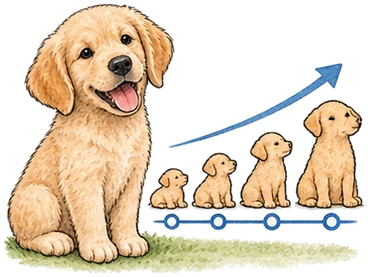
From 8 to 12 weeks, the typical toy-breed puppy gains 0.31 pounds a week and the typical giant-breed puppy 2.90. In between, small breeds gain 0.56, medium breeds 0.77, medium-large breeds 1.88 and large breeds 2.31. Those medians hold roughly steady until about 16 weeks and then fall, and by the second half of the first year many small dogs gain nothing from one weigh-in to the next. The numbers come from our analysis of 3.0 million pairs of weigh-ins at US Banfield vet clinics1.
How much weight should a puppy gain each week?
Size groups follow the breed's average adult weight: toy under 14 pounds, small 14 to 20, medium 20 to 33, medium-large 33 to 66, large 66 to 88 and giant over 88. Each cell gives the median gain in pounds per week, with the middle half in parentheses: a quarter of weigh-in pairs gained less than the lower figure and a quarter more than the upper figure.
| Size group (adult weight) | 8-12 wk | 12-16 wk | 16-20 wk | 20-26 wk | 26-39 wk | 39-52 wk |
|---|---|---|---|---|---|---|
| Toy (under 14 lb) | 0.31 (0.19 to 0.46) | 0.28 (0.16 to 0.44) | 0.22 (0.10 to 0.38) | 0.15 (0.03 to 0.30) | 0.07 (0.00 to 0.20) | 0.02 (-0.07 to 0.15) |
| Small (14 to 20 lb) | 0.56 (0.39 to 0.74) | 0.51 (0.33 to 0.71) | 0.40 (0.22 to 0.62) | 0.28 (0.09 to 0.50) | 0.13 (0.00 to 0.34) | 0.03 (-0.10 to 0.23) |
| Medium (20 to 33 lb) | 0.77 (0.55 to 1.03) | 0.75 (0.50 to 1.03) | 0.63 (0.37 to 0.93) | 0.46 (0.18 to 0.77) | 0.23 (0.00 to 0.53) | 0.07 (-0.12 to 0.33) |
| Medium-large (33 to 66 lb) | 1.88 (1.48 to 2.28) | 1.94 (1.48 to 2.40) | 1.75 (1.24 to 2.27) | 1.39 (0.82 to 1.98) | 0.73 (0.15 to 1.34) | 0.24 (-0.16 to 0.77) |
| Large (66 to 88 lb) | 2.31 (1.83 to 2.79) | 2.38 (1.84 to 2.91) | 2.11 (1.52 to 2.70) | 1.69 (1.04 to 2.34) | 0.93 (0.26 to 1.62) | 0.29 (-0.12 to 0.91) |
| Giant (over 88 lb) | 2.90 (2.30 to 3.53) | 3.13 (2.46 to 3.83) | 2.91 (2.18 to 3.66) | 2.43 (1.62 to 3.25) | 1.48 (0.60 to 2.36) | 0.56 (0.00 to 1.36) |
The data come from the open dataset released with Salt and colleagues' 2017 study, covering purebred dogs seen at US Banfield Pet Hospital clinics from 1994 to 2013. Pairing each weigh-in with the same dog's next one, when it came 2 to 6 weeks later, gave 3.0 million pairs from 1.23 million puppies1. We left out visits flagged as underweight or overweight; our methods page has the details. The table starts at 8 weeks, so for the first weeks of life see newborn puppy care week by week.
Weekly gain when you know the adult weight
If you have an adult-weight estimate, from a breed standard, the parents, the puppy weight calculator or the adult size calculator for a mix, this table follows the typical puppy at that weight. It uses our growth curves, fitted to about 4.2 million weigh-ins from about 710,000 purebred dogs with a recorded adult weight1. Figures are pounds per week, averaged across each age band.
| Adult weight | 8-12 wk | 12-16 wk | 16-20 wk | 20-26 wk | 26-39 wk | 39-52 wk | Fastest gain around |
|---|---|---|---|---|---|---|---|
| 10 lb | 0.30 | 0.32 | 0.27 | 0.20 | 0.10 | 0.04 | week 10 |
| 20 lb | 0.62 | 0.67 | 0.58 | 0.44 | 0.23 | 0.10 | week 13 |
| 40 lb | 1.20 | 1.31 | 1.19 | 0.99 | 0.52 | 0.18 | week 13 |
| 60 lb | 1.78 | 1.95 | 1.80 | 1.54 | 0.81 | 0.25 | week 13 |
| 80 lb | 2.26 | 2.48 | 2.38 | 2.00 | 1.13 | 0.40 | week 13 |
| 100 lb | 2.71 | 2.94 | 3.02 | 2.62 | 1.48 | 0.62 | week 20 |
The two tables will not match row for row, since a size group spans a range of adult weights and this one comes from smoothed curves. The first table also files each pair under its starting age, so a pair from week 11 to week 16 counts toward 8 to 12 weeks. If you are still estimating adult size, shortcuts like doubling the 16-week weight can miss badly for big dogs, as our test of six puppy weight formulas shows.
When do puppies gain weight fastest?
In our curves, weekly gains in pounds start to fall at about 4 months for a small dog and about 5 months for a giant1. The single fastest week lands around week 13 for adult weights of 20 to 80 pounds and around week 20 for 100 pounds, but the top is broad rather than a spike. A 10-pound adult, listed at week 10, stays between 0.27 and 0.32 pounds a week from 8 to 20 weeks.
The slowdown that follows is long. A puppy headed for 60 pounds averages 1.95 pounds a week at 12 to 16 weeks, 1.54 at 20 to 26 and 0.25 at 39 to 52. Measured against its own body weight the drop looks steeper: about 10.5% a week at 12 weeks, 8% at 16 weeks and 2.6% at 26 weeks1.
By 26 weeks, a puppy headed for 10 pounds has typically reached 76% of its adult weight, one headed for 60 pounds 69% and one headed for 100 pounds 64%1. Merck's reference text has growth starting to flatten after 6 months and says it can finish by 8 to 12 months for small and medium dogs but may take until 10 to 16 for large and giant ones2. The puppy growth chart shows these shares for every size, and our guide to when dogs stop growing covers the growth plates and the filling out that follow.
Is it normal for gain to stall after 6 months?
Yes, especially in small dogs. This table shows the share of weigh-in pairs where the second weight matched the first or came in lower1. At 8 to 12 weeks that is uncommon in every size group.
| Size group | 8-12 wk | 16-20 wk | 26-39 wk | 39-52 wk |
|---|---|---|---|---|
| Toy | 5.7% | 13.5% | 37.3% | 49.3% |
| Medium-large | 1.6% | 3.9% | 20.9% | 39.1% |
| Giant | 1.5% | 2.9% | 14.4% | 32.7% |
On our curves, a puppy that will weigh 10 pounds as an adult is at 89% of that by 39 weeks and 94% by 52, so little is left to add. Among real toy-breed puppies the median gain is 0.07 pounds a week from 26 to 39 weeks, about an ounce, and 0.02 after that, under half an ounce1. A meal or a switch of scales can outweigh that, which helps explain why about half of toy pairs between 39 and 52 weeks show no gain.
How do you weigh a puppy at home?
Scale precision matters more than technique. At 8 to 12 weeks a toy puppy's median gain is 0.31 pounds a week, about 5 ounces1. A scale that steps in half pounds cannot show that reliably, and one that rounds to whole pounds can be off by a pound once you subtract. These steps are general practice; none of our veterinary sources lays out a home method.
- Pick the scale by size. A kitchen scale that reads grams or tenths of an ounce suits toy and small puppies; a bathroom scale suits bigger ones.
- Take the reading. On a kitchen scale, put a shallow box on it, zero the scale, then set the puppy inside, and divide ounces by 16 for decimal pounds: 3 pounds 6 ounces is 3.375. On a bathroom scale, weigh yourself alone, then holding the puppy, and subtract: 163.8 minus 152.4 leaves 11.4 pounds.
- Keep the conditions the same. Use one scale on one hard-floor spot at the same time of day, before a meal and after a potty trip, so a full stomach or bladder stays out of the number.
- Log the date, the age in weeks and the weight, and bring the log to vet visits.
How often should you weigh a puppy?
Weekly, says the Merck Veterinary Manual, which advises adjusting feeding so a growing puppy gains a bit of weight every week2. After about 6 months, toy and small dogs typically add about 2 ounces a week or less1, so we suggest weighing every 2 to 4 weeks, long enough for the change to show on a home scale.
Is a slow week or a fast week a problem?
Judge 2 to 4 weeks at a time. The ranges above come from weigh-ins 2 to 6 weeks apart, so a single week can land outside them without anything being wrong. Take a made-up puppy, 12 weeks old and expected to reach 60 pounds:
| Age | Weight (lb) | Change (lb) |
|---|---|---|
| 12 weeks | 17.4 | start |
| 13 weeks | 19.7 | +2.3 |
| 14 weeks | 21.0 | +1.3 |
| 15 weeks | 23.6 | +2.6 |
| 16 weeks | 24.9 | +1.3 |
Three of the four single weeks fall outside the middle half for a medium-large puppy at 12 to 16 weeks, which is 1.48 to 2.40 pounds1. Across the four weeks the puppy gained 7.5 pounds, an average of 1.875 a week, close to the group's median of 1.94, so the uneven weeks were noise.
Had the four-week average come in low, re-weigh under the same conditions and feel along the ribs, then check portions against the dog food calculator and our guide to feeding a puppy. One low stretch is common, since by definition a quarter of pairs fall below the middle half1. By our rule of thumb, a second low stretch in a row is worth raising with your vet. An average above the range deserves the same checks, since the Merck manual calls slow growth preferable to fast growth2.
What weekly gain does not tell you
Pounds per week measure speed, not shape. Two puppies headed for the same adult weight can gain the same amount each week while one carries more fat, and the scale alone cannot say which. Body condition, judged by hand and eye, answers that. Our guide to whether your dog is overweight shows how to score it, and AAHA's 2019 life stage guidelines put body weight and body condition score inside the nutritional assessment that a thorough exam should include at every age3.
When is slow gain or weight loss a reason to call the vet?
The veterinary references we read set no number of weeks, so the thresholds below are our own, built on how rare a flat weight is in the clinic data. Parasite guidance does tie poor growth to treatable problems, though. CAPC lists poor weight gain and a pot-bellied look among the signs of roundworms in puppies4; for hookworms it pairs the same poor gain with pale gums, anemia and dark, tarry diarrhea5. Merck names a lack of growth as the first sign of roundworms in young animals6. Parasites are one possible cause among many, and only an exam sorts them out.
- Same day: weight loss or no gain with repeated vomiting, diarrhea, weakness, refusing food, pale gums or dark, tarry stool. Heavy hookworm infections can kill young puppies without prompt treatment5, and long-running cases bring weakness and loss of appetite7.
- Within a day or two: a flat or lower weight across two weigh-ins a week or more apart before about 16 weeks. Only 5.7% of toy pairs and 1.5% of giant pairs showed no gain at 8 to 12 weeks1.
- This week: a flat or falling weight between 16 weeks and 6 months, especially in a medium-large or giant puppy, where only 3.9% and 2.9% of pairs showed no gain at 16 to 20 weeks, against 13.5% of toy pairs1.
- Next visit: a toy or small dog past 6 months holding a steady weight while eating well and feeling neither bony nor soft over the ribs, a pattern that is common in our data1.
Bring your weight log, the date of the last deworming and a fresh stool sample if you can, since parasite checks are done on feces6.
Common questions
How much should a puppy gain per month?
A month is about 4.3 weeks, so multiply the weekly median by 4.3. From 8 to 12 weeks that comes to about 1.3 pounds a month for a toy breed (0.31 × 4.3) and 8.1 for a medium-large breed (1.88 × 4.3). From 39 to 52 weeks the same math gives about 0.1 and 1.0 pound1. These are medians, so check the middle-half range in the first table before deciding a month was slow or fast.
Which size group should a mixed-breed puppy use?
Pick the group that matches the adult weight you expect: toy under 14 pounds, small 14 to 20, medium 20 to 33, medium-large 33 to 66, large 66 to 88, giant over 88. The how big will my puppy get tool estimates adult weight from age and current weight. The dataset behind our tables holds no mixed breeds1, so treat the ranges as a rougher guide for a mix and lean on the 2-to-4-week trend.
How many grams a day should a puppy gain?
The Merck Veterinary Manual puts the average at 2 to 4 grams a day per kilogram of expected adult weight over the first 5 months2. A puppy headed for 60 pounds (27.2 kg) would gain 54 to 109 grams a day, or 0.84 to 1.68 pounds a week. Our 60-pound curve averages about 1.7 pounds a week from 8 to 26 weeks1, and curves for 10 to 100 pounds all land within 5% of the top figure, so typical puppies sit at the high end.
Does feeding a puppy more make it grow faster?
It makes the puppy gain faster, which is not the goal. The Merck Veterinary Manual says overfeeding during growth speeds up the growth rate, which works against proper bone development and adds to the risk of obesity later, and that slow growth is better than fast2. Feed by the puppy's age and weight, check body condition, and ask your vet before changing portions in a large or giant breed.
Is gaining 5 pounds in one week too much for a puppy?
Five pounds is more than the upper edge of the middle half in every size group; the highest edge is 3.83 pounds a week, for giant breeds at 12 to 16 weeks1. That makes it a fast week for any size, though a single week is noisy. First re-weigh under the same conditions, since a different scale or a full stomach can skew one reading. If a second weigh-in agrees, ask your vet whether portions and body condition are on track.
Should I weigh my puppy every day?
For small puppies, daily weigh-ins mostly capture noise. A toy puppy's median gain at 8 to 12 weeks, 0.31 pounds a week, is about 0.04 pounds or 0.7 ounce a day1, which a meal or a potty trip can easily swamp. The Merck Veterinary Manual advises checking a growing puppy's weight gain weekly2, and a weekly log shows the trend with far less scatter.
See Pet scales on Amazon. As an Amazon Associate we earn from qualifying purchases.
 Sources
- Salt C, Morris PJ, German AJ, Wilson D, Lund EM, Cole TJ, Butterwick RF, Growth standard charts for monitoring bodyweight in dogs of different sizes, PLOS ONE 12(9): e0182064, 2017 (open dataset: doi:10.17638/datacat.liverpool.ac.uk/377, CC BY 4.0)
- Sanderson SL, Merck Veterinary Manual (professional version), Feeding Practices in Small Animals, reviewed Nov 2023, updated Oct 2024
- American Animal Hospital Association, 2019 Canine Life Stage Guidelines, 2019
- Companion Animal Parasite Council, Ascarid: guidelines for dogs, last updated February 28, 2025
- Companion Animal Parasite Council, Hookworms: guidelines for dogs, last updated February 28, 2025
- Peregrine AS, Merck Veterinary Manual (professional version), Roundworms in Small Animals, reviewed Jul 2023, updated Jul 2026
- Peregrine AS, Merck Veterinary Manual (pet owner version), Gastrointestinal Parasites of Dogs, reviewed May 2018, updated May 2026
General information, not veterinary advice. If your pet is unwell, call your vet.
