
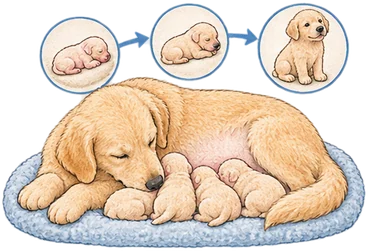
A newborn puppy needs colostrum within its first day and air kept at 84 to 89°F for the first week.12 Its weight should climb steadily after at most a brief dip on day 1, and the average puppy in one large study gained 67% by day 7, ending the week at about 1.7 times its birth weight.13 Deworming starts at 2 weeks and first vaccines come at 6 to 8 weeks.45 A cold puppy, or one that will not nurse or is losing weight, needs a vet right away.16
Newborn puppy care week by week
Days count from birth, and "dam" means the mother. Air temperatures are the Merck Veterinary Manual's recommended ranges, and its table stops at week 5.1 Deworming dates come from CAPC.4
| Age | Air temperature | What is happening | What you do |
|---|---|---|---|
| First 24 hours | 84-89°F (29-32°C)1 | Antibodies cross from colostrum into the blood only during roughly the first 12 to 24 hours.12 | Weigh each puppy at birth and at 24 hours. Watch every puppy latch on. |
| Week 1 (days 2-7) | 84-89°F (29-32°C) | Eyes and ears are closed. The dam's licking makes the puppies pee and poop.7 | Weigh daily.1 Call the vet if a puppy stops gaining.6 |
| Week 2 (days 8-14) | 80°F (27°C)1 | Eyes and ears start to open; Merck dates this stage to days 13 to 19, Texas A&M to weeks 2 to 4. Puppies begin to eliminate without the dam's help.57 | Weigh daily to day 14.1 First deworming at 14 days.4 |
| Week 3 (days 15-21) | 80°F (27°C) | The socialization window opens around day 19.7 Some puppies try solid food.8 | Weigh every third day through the first month.1 Offer soft puppy food in a bowl once they show interest.5 |
| Week 4 (days 22-28) | 69-75°F (21-24°C)1 | Puppies start to regulate their own body temperature around now.1 | Second deworming at 28 days.4 |
| Weeks 5-6 (days 29-42) | 69°F (21°C) in week 51 | Four or five small daily meals of puppy food start alongside nursing.5 | Third deworming at 42 days.4 Book the first vaccine visit for 6 to 8 weeks.5 |
| Weeks 7-8 (days 43-56) | Not listed | Weaning ends around 7 weeks.7 Puppy classes can start at 7 to 8 weeks.9 | Fourth deworming at 56 days, then a monthly preventive.4 Eight weeks is the usual minimum age to go home.8 |
Colostrum and the first day
Puppies are born with almost no antibodies of their own.2 They get them from colostrum, the dam's first milk, which carries 20 to 30 g of the antibody IgG per liter against less than 1 g in later milk, and the level falls by about half within a day.2 The gut can absorb those antibodies for a short time only: one review puts the end at 12 to 16 hours after birth,2 and Merck says absorption generally stops by 24 hours.1
That makes the first day a deadline for every puppy. In a study of 514 puppies, weight change from birth to 48 hours stood in for colostrum intake, and puppies that lost 4% or more in that window were likelier to die between day 2 and day 21.10 A puppy that still has not nursed a few hours after birth is worth a call to your vet while that window is open.
How much weight a newborn puppy should gain
Weigh each puppy at birth on a scale that reads in single grams (an ounce is about 28 g), since the table below measures change from birth weight. Merck's schedule is daily weigh-ins through day 14, then every third day until a month old. The manual accepts a short loss of up to 10% on day 1 and puts normal gain at 5% to 10% of body weight a day. It also gives a second rule, 1 to 3 g a day per kilogram (2.2 lb) of expected adult weight, and does not say which to prefer.1
The most detailed numbers come from a 2023 study of 8,550 puppies from 24 breeds and 127 French kennels, in which breeders recorded daily weights on their own scales.3 Puppies were sorted into low or normal birth weight by breed-specific cutoffs (15% were low). The table gives the average change and each group's cutoff that best separated puppies that died within two months from those that lived.3
| Weigh-in | Average puppy | Warning line, normal birth weight | Warning line, low birth weight |
|---|---|---|---|
| 24 hours | up 1.6% | down more than 4.1% | down more than 1.8% |
| 48 hours | up 7.3% | down more than 8.7% | down more than 0.4% |
| Day 7 | up 67% | up less than 26% | up less than 31% |
The average puppy is already above birth weight at 24 hours, and its 67% gain by day 7 works out to about 7.6% a day, compounded, inside Merck's 5 to 10% range.13 Below the lines, deaths in the first two months were far more common. At 48 hours, 23% of normal-weight puppies past the line died against 3.2% of the rest, and 37% of low-weight puppies against 9.2%.3
Read the lines as a reason to call your vet, not a diagnosis. They are associations in voluntary breeder reports from one country, and the authors advise caution in applying them elsewhere.3 How much early loss is harmless is also unsettled. Merck accepts up to 10% on day 1 and the 514-puppy study flagged 4% by 48 hours,110 while the 2023 paper cites a study of Boxers from a single kennel that reported an 11.3% loss over the first 3 days and called it physiological.3
Take a 380 g puppy, the median birth weight in the French data.3 At the average rate it would weigh 408 g at 48 hours (380 × 1.073) and 635 g at day 7 (380 × 1.671). Its normal-weight warning lines at those weigh-ins are 347 g (380 × 0.913) and 479 g (380 × 1.26); the low-weight lines are 378 g and 498 g. Low birth weight is set by breed, so if you cannot tell which line applies, use the tighter one. Large litters tend to have more low-birth-weight puppies,10 which is one reason to read how many puppies will my dog have before the birth.
Keeping the whelping area warm
Have the box warm before the first puppy arrives; the dog pregnancy calculator gives the due-date window, and the dog pregnancy week by week guide covers the run-up.
Puppies lack working thermoregulation until about 4 weeks of age, and newborns also carry very little body fat, so the air around them has to supply the heat.1 Their rectal temperature runs lower than an adult dog's,6 at 95 to 99°F in week 1, 97 to 100°F in weeks 2 and 3, and 99 to 101°F in week 4 by Merck's table.1 Its text, though, wants the room warm enough to hold body temperature at 97°F (36°C) or more, above the bottom of that week-1 range.1 Chilling hurts immunity, nursing, and digestion.1
Merck's table does not say where in the box to measure, so read a thermometer at puppy level.1 The manual prefers an overhead heat lamp hung far enough away to avoid overheating, since heating pads can burn puppies that cannot crawl away, and it recommends humidity of 55% to 65%.1 Warm a chilled puppy back up slowly, over 30 to 60 minutes, so it does not dehydrate, and hold any tube feeding until its temperature is normal.1 Call your vet while you do.
Signs of a fading puppy that need a vet today
Fading puppy syndrome is the name for a newborn that fails to thrive without one clear cause.6 The first week is the riskiest. In the French data, 8.9% of live-born puppies died within 2 months; most deaths came in the first week and 88% before day 21,3 and Merck cites neonatal death rates of 9% to 26%, highest in week 1.1 Puppies this young can go downhill fast, so call your vet right away for any of these:6
- Failure to nurse or suckle well.16
- A flat or falling weight, or one below the warning lines above. Illinois calls lack of weight gain usually the first sign.6
- Restless crying that nursing does not settle.6
- A cold body, or a rectal temperature below the range for its week; Merck treats under 96°F as chilling that raises sepsis risk. A reading that runs too high counts too.16
- Persistent diarrhea, vomiting or regurgitation, a swollen or painful belly, blood in the urine, or trouble breathing.1
While you arrange the visit, keep the puppy warm and bring the weight log. Illinois says puppies that are weaned and eating solid food are past the danger of fading puppy syndrome.6
Nursing and toileting
None of the veterinary sources we read gives a standard number of feedings a day for a healthy litter, so judge nursing by its results: a well-fed newborn sleeps quietly between feeds and gains weight.1 After a cesarean, until the dam has recovered and is mothering well, Merck has nursing supervised and allowed every 1 to 2 hours.1 A dam who refuses to nurse at all needs your vet's help that day.
Until the transitional stage at about 13 to 19 days, puppies depend on the dam's grooming to eliminate, and it also prompts them to eat and stay in the nest.7 Orphans, or a litter whose dam is not grooming, need that stimulation by hand; your vet can show you how.
Deworming, weaning, and first vaccines
CAPC's dog guideline starts worming at 2 weeks and repeats it every 2 weeks until a monthly roundworm product takes over at 4 to 8 weeks.4 Its treatment section names pyrantel pamoate at weeks 2, 4, 6, and 8 and says to treat the nursing dam alongside her litter.4 Roundworm larvae can cross the placenta, and puppies infected before birth do not shed eggs until 2.5 to 3 weeks old, so the early doses aim to keep eggs out of the environment.4 The puppy deworming schedule lays out the timeline, and your vet picks the product and dose.
Some puppies try solid food by 3 weeks of age while they are still nursing.8 Texas A&M's veterinary college suggests soft food in a bowl once they show interest, then four or five small daily meals of puppy food at 5 to 6 weeks.5 Merck puts the end of weaning at about 7 weeks, and Cornell says most puppies are fully weaned between 7 and 10 weeks.78 Vaccination begins at 6 to 8 weeks, on a schedule your vet sets.5
Socialization starts in the whelping box
Merck dates the socialization period from about day 19 to 12 weeks.7 AVSAB's position statement calls for handling puppies from birth so they learn to accept touch, and says classes can begin at 7 to 8 weeks once a puppy has had a first deworming and at least one set of vaccines 7 or more days earlier.9 The puppy socialization schedule carries the plan past 8 weeks.
After week 8: from birth weights to growth charts
Our analysis of the Salt et al. (2017) growth data covers about 4.2 million puppy weigh-ins from about 710,000 purebred dogs at US Banfield Pet Hospital clinics. In it, the typical dog that reached 20 lb as an adult weighed about 23% of that at 8 weeks (4.6 lb), and one that reached 100 lb weighed about 13% (13 lb). Enter your puppy's age and weight in the puppy weight calculator for an adult-weight estimate, or plot it on the puppy growth chart.
Common questions
Should newborn puppies see a vet right after birth?
Merck recommends a full physical exam on the first day after a natural birth, to confirm the palate is closed, the umbilicus looks normal, and the urethral and anal openings work.1 It also says veterinary care right after birth improves the puppies' survival and reduces illness in the dam.1 Ask your vet before the due date how they handle post-whelping checks, and call at once if any puppy is struggling.
How long can a newborn puppy go without nursing?
We found no published safe interval. Merck explains why the margin is thin: newborns carry almost no fat reserves, their stored sugar runs out soon after birth, and even a brief fast can cause low blood sugar.1 A puppy that is not nursing needs a call to your vet right away, and Merck lists failure to suckle among the signs of sepsis.1
What counts as a low-birth-weight puppy?
It depends on the breed. In the French study of 8,550 puppies, birth weights ran from 56 g to 940 g, and the low-weight cutoff was set breed by breed; 15% of puppies fell below their breed's line.3 Another study defined it as the bottom quarter by weight within a breed size.10 Merck lists under 350 g in a medium-size breed as a sepsis risk factor.1 Ask your vet where each puppy falls for its breed.
What causes fading puppy syndrome?
It has no single cause. The University of Illinois names an inappropriate environment, birth defects, problems with the dam, and umbilical infections, and adds that litters from older dams are affected more often.6 Merck's risk factors for bacterial sepsis add a prolonged delivery, a contaminated environment, stress, and chilling, along with infection of the dam's uterus or mammary glands.1
How long should puppies stay with their mother?
Cornell calls 8 to 12 weeks the ideal window, with 8 weeks a good minimum, and notes that some states bar selling younger puppies. It says research links an earlier move to more fear, aggression, anxiety, and play biting than a stay of 8 weeks or longer. Toy breeds are often kept until 12 weeks.8
See Gram scales for weighing newborn puppies on Amazon. As an Amazon Associate we earn from qualifying purchases.
 Sources
- Davidson AP, Merck Veterinary Manual, Management of the Neonate in Dogs and Cats (reviewed December 2022, updated August 2025)
- Chastant-Maillard S, Aggouni C, Albaret A, Fournier A, Mila H, Canine and feline colostrum, Reproduction in Domestic Animals 52(Suppl 2):148-152, 2017
- Mugnier A, Gaillard V, Chastant S, Relative impact of birth weight and early growth on neonatal mortality in puppies, Animals 13(12):1928, 2023
- Companion Animal Parasite Council, Ascarid guidelines for dogs (updated February 2025)
- Texas A&M University College of Veterinary Medicine & Biomedical Sciences, The Puppy Timeline: Physical and Mental Changes (Pet Talk), May 2023
- Lamp A, University of Illinois College of Veterinary Medicine, Fading Puppy Syndrome: When Puppies Fail to Thrive, November 2023
- Borns-Weil S, Merck Veterinary Manual, Social Behavior of Dogs, behavioral development section (reviewed September 2025)
- Cornell University College of Veterinary Medicine, Riney Canine Health Center, How long should puppies stay with their mother?
- American Veterinary Society of Animal Behavior, Position Statement on Puppy Socialization, 2008
- Mila H, Grellet A, Feugier A, Chastant-Maillard S, Differential impact of birth weight and early growth on neonatal mortality in puppies, Journal of Animal Science 93(9):4436-4442, 2015
General information, not veterinary advice. If your pet is unwell, call your vet.
