
Home › Guides › How Many Puppies Will My Dog Have?
How Many Puppies Will My Dog Have?
Most litters hold 3 to 7 puppies, and breed size moves the average from about 3.5 in miniature breeds to about 7 in giant ones. To count the puppies in your own dog, a vet's X-ray after about day 55 of pregnancy is the best method.
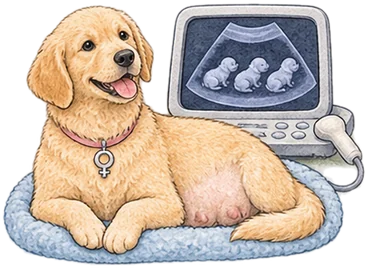
The average dog litter is between 5 and 6 puppies, rising from about 3.5 in miniature breeds to about 7 in giant ones.12 Registry data from the Norwegian Kennel Club, covering 10,810 litters from 224 breeds in 2006 and 2007, gave a mean of 5.4 puppies born.1 About two litters in three held 3 to 7 puppies. Another 13% held one or two, and 7% held ten or more.3 A New Zealand breeding practice that followed 1,203 inseminations found a mean of 5.8, with a standard deviation of 3.1 puppies.2
These figures come from observational data: kennel club registries, where breeders report each litter,34 and one clinic's breeding records.2 Your own dog can land well above or below the average for her group.
Litter size by breed size
A follow-up paper on the same Norwegian litters sorted the 224 breeds into five size groups by the midpoint of the weight range in each breed standard.3 The table sets their group averages beside example breeds from the Danish Kennel Club's litters of August 2022 to July 2023, grouped by the median breed weight the Danish study lists.4
| Breed size group (breed weight) | Norway: puppies born3 | Norway: alive on day 83 | Danish example breeds (average litter)4 |
|---|---|---|---|
| Miniature (under 5 kg, under 11 lb) | 3.5 | 3.3 | Chihuahua 2.0 to 2.5, Pomeranian 2.3, Yorkshire terrier 3.6 |
| Small (5 to 10 kg, 11 to 22 lb) | 4.2 | 3.9 | Jack Russell terrier 4.0, Cavalier King Charles spaniel 4.1, Havanese 4.9 |
| Medium (10 to 25 kg, 22 to 55 lb) | 5.7 | 5.3 | English cocker spaniel 4.8, Border collie 5.9, English springer spaniel 6.3 |
| Large (25 to 45 kg, 55 to 99 lb) | 6.9 | 6.3 | German shepherd (short-haired) 5.7, Labrador retriever 6.7, Golden retriever 7.2 |
| Giant (over 45 kg, over 99 lb) | 7.1 | 6.3 | Newfoundland 5.2, Mastiff 5.3, Great Dane 6.8 |
Norwegian birth figures are our division of that paper's puppy and litter counts and match the 3.5 and 7.1 the first paper reported for miniature and giant breeds.13 Day 8 figures run lower because stillborn puppies and first-week deaths drop out.3 Danish litter sizes are reported by breeders and may fall anywhere between puppies born and puppies born alive.4 Breeds with few litters give rough averages: the Mastiff figure rests on 13 litters and the Great Dane on 22.4 Typical adult weights for each breed are on the breeds index.
At the top the climb flattens. Norwegian large and giant breeds averaged 6.9 and 7.1 puppies born, but 11.6% of giant-breed puppies were stillborn or died in the first week, against 8.8% in large breeds, so both groups stood at 6.3 on day 8.3 Sorted by the same cutoffs (our grouping, weighted by litters), the 115 Danish breeds average 3.1, 4.2, 5.5, about 6.3, and 6.1 from miniature to giant.4 The New Zealand practice's own size groups disagree at the top: giants averaged 6.7 puppies and large breeds 5.9.2 The Danish authors found that the smallest and largest breeds both fall short of a steady trend, possibly because fetuses are large relative to the mother in tiny breeds and giants run short of room in the uterus.4
Weight alone is a rough guide: in the Danish table, short-haired German shepherds average 5.7 puppies, Labradors 6.7, and golden retrievers 7.2, though their median weights all fall between 30 and 33 kg (66 to 72 pounds).4 Skull shape matters too, since with weight held equal, flat-faced (brachycephalic) breeds had expected litters 25% smaller; short-legged breeds such as dachshunds showed no significant difference.4 A French bulldog and a beagle share a median weight of 11 kg (24 pounds) but average 4.4 and 5.2 puppies.4
Does the mother's age change the number?
Yes, and the pattern is a hill. Dividing the Norwegian puppy counts by litters gives 4.7 puppies born to one-year-old mothers, about 5.5 to 5.6 for mothers aged 3 to 6, and 5.0 for 8-year-olds.3 Losses also rose with age, from 7.1% of puppies at age 2 to 13.4% at age 8, so by day 8 the averages ran 4.3 at age 1, a peak of 5.2 at ages 3 and 4, and 3.9 at age 8.3 The first Norwegian paper, which adjusted for breed, found that the expected number born fell faster with age in large breeds.1
Age cost 0.13 puppies per added year in the New Zealand practice's analysis, so a bitch four years older would be expected to have about half a puppy fewer (4 × 0.13 = 0.52).2 Swedish records for the Drever breed show the same turn, with litter size falling after age 5.5
Do first litters have fewer puppies?
Not reliably. In a model that accounted for breed, the first Norwegian paper found no effect of parity, meaning whether it was her first litter or a later one, on litter size at birth.1 Raw day-8 averages in the follow-up paper drop from 5.2 puppies in first litters to 4.4 in fifth litters, but a bitch is older at each later litter, so age probably explains part of that drop.3 The Drever records add two details: a first litter born after age 4 was smaller than a younger bitch's, and in one private kennel the number born rose from the first litter to the third before falling.5
What a first litter changes is the risk. In the follow-up study, 8.5% of puppies in first litters were stillborn or died in the first week, against 7.5% to 7.8% in litters two to four.3 A first litter from a mother older than 6 carried about three times the odds of including a stillborn puppy, and the Norwegian Kennel Club recommends against breeding a bitch for the first time after that age.3 First-time mothers older than 6 are also prone to single-puppy pregnancies and long labors, according to a review of newborn puppy survival.6
Do breeding method, timing, the sire, or inbreeding matter?
The method of mating had a significant effect on litter size in the Norwegian registry,1 and the review sums up that result as larger litters from natural mating than from artificial insemination.6 Fresh semen beat frozen-thawed semen in the New Zealand cohort, 6.2 puppies per litter against 5.4.2
Evidence on timing is thin. Drever bitches mated only once had smaller litters, but one breed's records can't show that a second mating adds puppies.5 If you want to time a mating, ask your vet about blood progesterone testing, which the review counts as a key measure for detecting ovulation.6 The dog heat cycle calculator projects the stages of a heat from your dates, and the heat length guide explains each one.
On the sire's side, Drever males differed in how often their matings produced a litter but not in litter size, which the authors took as pointing to the bitches rather than the sires.5 Litter size is only weakly inherited, with heritability estimates of 6% to 11% across seven French breeds.7 In those breeds, higher inbreeding went with smaller litters and lower survival. The authors judged ordinary inbreeding within a breed to have a limited effect, while matings between close relatives significantly reduced litter size and longevity.7
How and when a vet can count the puppies
An X-ray taken after about day 55 of pregnancy is the best way to count puppies, according to the Merck Veterinary Manual.8 Fetal skeletons begin to show on routine films at about day 42 to 45 and are prominent by day 47 or 48, but the manual singles out the late film for counting.8
Ultrasound works earlier, best at 25 to 35 days, when it confirms the pregnancy and shows whether the fetuses are alive; a scan before day 21 can give a false negative.8 Early pregnancy also loses embryos to resorption: of 87 pregnancies scanned 21 to 30 days after ovulation at the University of Pisa's veterinary hospital, 42 (48%) already had at least one resorption site, and 14% of all the structures counted were resorption sites.9 A tally from an early scan can therefore differ from the number born.
Your vet will pick the day for the film. To plan around it, the dog pregnancy calculator turns a mating date into a whelping window of day 56 to 68.
What a very large or single-puppy litter means for whelping
Litter size changes how delivery goes at both ends. This table sorts the Norwegian litters by how many puppies were born, and sizes not shown fall between the rows.3
| Puppies born | Share of litters | Puppies stillborn or dead in week one | Litters with a stillborn puppy |
|---|---|---|---|
| 1 | 4.9% | not available | not available |
| 2 | 8.1% | 6.5% | 6.7% |
| 4 | 14.8% | 6.9% | 11.5% |
| 6 | 13.2% | 7.4% | 15.6% |
| 8 | 7.9% | 7.7% | 20.5% |
| 10 | 3.5% | 9.8% | 36.1% |
| 12 or more | 1.9% | 19.9% | 56.0% |
The share column is our division of the paper's litter counts by 10,810. The one-puppy row has no loss figures because litters in which every puppy died were not reported to the kennel club, and the authors think most of those held a single puppy.3
Losses stay between 6% and 8% of puppies for litters of two to eight, then climb: litters of 12 or more lost about one puppy in five, and more than half had a stillborn puppy.3 Each added puppy raised the odds that a litter included a stillborn puppy by about 10%, even after adjusting for breed, the mother's age, and litter number.3 In two guide-dog breeding colonies, puppies in litters of 11 or more were 1.45 times as likely to be stillborn, and the last puppy born was more likely to be stillborn at any litter size.10 The newborn survival review describes the mechanism: with 12 or more puppies the uterine wall can stretch until contractions start weak (primary inertia), or a long labor can exhaust the muscle (secondary inertia).6
About 1 in 20 Norwegian litters (4.9%) held a single puppy, and for the reason above the true share is probably higher.3 Small litters bring their own delivery trouble: in the guide-dog colonies, 36.5% of litters under five puppies had a difficult birth (dystocia), against 22.1% of mid-sized litters and 26.9% of litters over nine.10 Cesareans followed the same pattern in the New Zealand practice, 83% of litters of one or two puppies against 43% of litters of three or more, though those counts include planned surgeries.2 In larger breeds, the review notes, a small litter may not send a strong enough signal to start labor.6
Each puppy above the average also shortened pregnancy a little, by 0.08 day in the New Zealand cohort and by about a quarter of a day in the Swedish Drever records.25 For a litter four puppies above average, that is roughly 8 hours earlier (4 × 0.08 = 0.32 day) to a full day earlier (4 × 0.25 = 1 day), small next to the 12-day whelping window.
If the X-ray shows a single puppy or ten or more, ask your vet whether to plan the delivery ahead; the review lists litter size among the reasons for a planned cesarean.6 Write the count at the top of your whelping chart and note the time each puppy arrives. If labor seems to have ended before the number born matches the count, or strong contractions stop while puppies remain, call your vet. The dog pregnancy week-by-week guide lists the time limits that mean it is time to call, and the newborn puppy care guide covers the weeks after the last puppy arrives.
Common questions
Which breeds have the biggest and smallest litters?
Among Norway's 100 most popular breeds, Rhodesian ridgebacks had the largest litters at birth, 8.9 puppies, while Pomeranians, toy poodles, and Norfolk terriers had the smallest, 2.2 puppies alive on day 8.3 In the Danish table, German wire-haired pointing dogs led at 8.1. Two flat-faced breeds came last, the Griffon Belge at 1.3 and the Griffon Bruxellois at 1.9, followed by smooth-haired Chihuahuas at 2.0.4 Breeds with few registered litters give shaky averages, so treat single-breed figures as rough.
How many puppies do French bulldogs, pugs, and other flat-faced breeds have?
Fewer than their weight suggests. The Danish averages were 4.4 for both French and English bulldogs, 4.0 for Boston terriers, and 3.7 for pugs.4 Flat-faced breeds also have more surgery: in the New Zealand practice they were 11.3 times as likely as other breeds to have a cesarean, planned or emergency.2 Ask your vet early about a delivery plan.
Does the time of year affect litter size?
The evidence conflicts. Norway's registry study of 224 breeds found no effect of birth season on the number of puppies born,1 while Swedish Drever records showed the largest litters arriving in spring.5 One result covers many breeds and the other a single breed, so neither supports timing a mating to a particular month. Breed size and the mother's age showed clearer effects in the Norwegian data.1
How old is too old for a dog to have puppies?
These studies set no hard upper age. The Norwegian Kennel Club advises against a first litter after age 6, and in its registry each added year of the mother's age raised the odds of a stillborn puppy in the litter by about 22%.3 In the New Zealand practice, the share of inseminations that produced a litter fell steadily with age,2 and in the guide-dog colonies the risk of a difficult birth rose with the mother's age.10 Ask your vet to assess an individual dog before any breeding.
Is an X-ray safe for the puppies?
The Merck Veterinary Manual says radiography at the stage when fetal skeletons show, from about day 42 to 45 on, is not teratogenic, meaning it does not cause birth defects.8 A film near term can also show fetal teeth, which vets use to judge whether puppies are mature enough for a planned cesarean when breeding dates are vague.8 Your vet decides whether and when to take the film, so ask what is recommended for your dog.
 Sources
- Borge KS, Tønnessen R, Nødtvedt A, Indrebø A, Litter size at birth in purebred dogs: a retrospective study of 224 breeds, Theriogenology 75(5):911-919, 2011
- Hollinshead FK, Hanlon DW, Factors affecting the reproductive performance of bitches: a prospective cohort study involving 1203 inseminations with fresh and frozen semen, Theriogenology 101:62-72, 2017
- Tønnessen R, Borge KS, Nødtvedt A, Indrebø A, Canine perinatal mortality: a cohort study of 224 breeds, Theriogenology 77:1788-1801, 2012
- Egeriis KH, Proschowsky HF, Guldbrandtsen B, Allometry of litter size in dog breeds, Acta Veterinaria Scandinavica 68:20, 2026 (with Additional file 2, breed table)
- Gavrilovic BB, Andersson K, Linde Forsberg C, Reproductive patterns in the domestic dog: a retrospective study of the Drever breed, Theriogenology 70(5):783-794, 2008
- Uchańska O, Ochota M, Eberhardt M, Niżański W, Dead or alive? A review of perinatal factors that determine canine neonatal viability, Animals 12(11):1402, 2022
- Leroy G, Phocas F, Hedan B, Verrier E, Rognon X, Inbreeding impact on litter size and survival in selected canine breeds, The Veterinary Journal 203(1):74-78, 2015
- Davidson AP, Pregnancy Determination in Bitches and Queens, Merck Veterinary Manual (professional version), full review June 2025, updated July 2026
- Lascialfari P, Tesi M, Manetti C, Fanelli D, Rota A, Embryonic resorption rates at canine pregnancy diagnoses: a retrospective evaluation, Theriogenology 206:71-77, 2023
- Cornelius AJ, Moxon R, Russenberger J, Havlena B, Cheong SH, Identifying risk factors for canine dystocia and stillbirths, Theriogenology 128:201-206, 2019
General information, not veterinary advice. If your pet is unwell, call your vet.
