
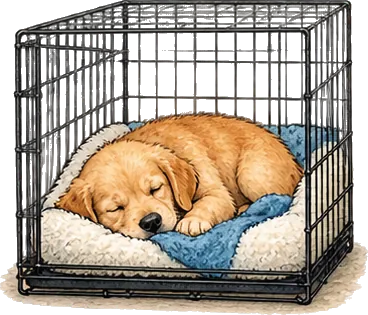
How long a puppy can stay in a crate, by age
No single official number exists, and the published rules don't agree. The behavior service at Ohio State's veterinary medical center gives a bladder rule of thumb: a puppy can hold it about about an hour per month of age, topping out near 10 hours 1. Peninsula Humane Society sets tighter crate limits: about 1 hour at a stretch until 4 months, 2 to 3 hours from 4 to 6 months, and no more than 5 hours from 6 months to a year 2. Humane World for Animals (formerly the Humane Society of the United States) caps puppies under 6 months at 3 to 4 hours, though the same page's FAQ allows one hour more than the age in months 3.
The hour-per-month rule is a bladder ceiling, so plan days around the shorter shelter limits.
| Age | Longest daytime crate stretch | Bladder rule of thumb | Night trips outside (8-hour night) |
|---|---|---|---|
| 8 to 12 weeks | About 1 hour while you're home 2 | About 2 to 3 hours | 2 or 3 |
| 3 to 4 months | About 1 hour 2 | 3 to 4 hours | 1 or 2 |
| 4 to 6 months | 2 to 3 hours 2, never over 3 to 4 3 | 4 to 6 hours | About 1 |
| 6 to 12 months | Up to 5 hours 2 | 6 to 10 hours | 0 or 1 |
| Adult | 4 to 5 hours by day 3 | Up to about 10 hours 1 | None; overnight crating is fine if the crate is comfortable 3 |
The bladder column applies Ohio State's hour-per-month rule 1, and the night column is our own arithmetic from that rule over an 8-hour night, not a published figure. Per the Merck Veterinary Manual, a dog can first hold back elimination on purpose at about 8½ weeks 4.
When you leave a puppy under 3 months, Peninsula puts it in a pen with the crate open, plus food, water, toys and a bathroom spot 2.
Overnight potty breaks
At first, set the crate up in your bedroom or just outside it, so you hear the puppy wake. Once the puppy sleeps through the night, you can move it wherever you like 3. A night trip should be dull. Take the puppy to the same spot, praise quietly when it goes, and go straight back to the crate with no play. Ohio State suggests giving a puppy 2 to 3 minutes to go 1. If nothing happens, put the puppy back and try again in 30 minutes, the interval Peninsula uses for daytime house training 2.
Worked example: an 11-week-old
Eleven weeks is about 2.5 months, so the rule of thumb puts the bladder limit near 2.5 hours. With bedtime at 10:30 p.m. and wake-up at 6:00 a.m., the night is 7.5 hours, and 7.5 ÷ 2.5 = 3 stretches, which means two alarms in between: 1:00 a.m. and 3:30 a.m., then the 6:00 a.m. wake-up trip. After four or five nights of waking dry, push the first alarm back 30 minutes. By about 17 weeks (close to 4 months), the rule covers stretches of nearly 4 hours, so a single alarm near 2:15 a.m. splits the 7.5-hour night in two.
Sample daily schedule for an 8 to 12 week old puppy
The schedule below is our own example, not a published plan. It is built on three published rules: take the puppy out about once an hour while it's awake 1, go out 15 to 30 minutes after a meal 4, and keep daytime crate stretches near an hour 2. Someone is assumed to be home. For portions, see how much to feed a puppy.
| Time | What happens | Crate? |
|---|---|---|
| 6:00 a.m. | Wake up, straight outside | No |
| 6:15 | Breakfast in the crate | Door closed about 10 minutes after eating |
| 6:45 | Potty trip, then play and a short training session | No |
| 8:00 | Potty trip, then nap with a chew toy | Yes, up to 1 hour |
| 9:00 | Potty trip, handling practice, new sights and sounds | No |
| 10:00 | Potty trip, nap | Yes, up to 1 hour |
| 11:00 | Potty trip, play | No |
| 12:00 p.m. | Lunch, potty trip 15 to 30 minutes later | Door open |
| 1:00 | Nap | Yes, up to 1 hour |
| 2:00 to 4:00 | Potty trip each hour, play, a short outing to meet people | One 1-hour nap |
| 5:00 | Dinner, potty trip 15 to 30 minutes later | Door open |
| 6:00 to 8:00 | Family time, potty trip each hour | No |
| 8:00 | Potty trip, nap | Yes, up to 1 hour |
| 9:00 to 10:30 | Quiet play, last potty trip at 10:30 | Bedtime crate at 10:30 |
| Night | Alarm trips, as in the worked example | Yes |
Go out after naps and play too 4. If you work away from home, crating through a full 8 to 10 hour day isn't appropriate at any age 2. A dog walker or sitter, daycare, or a puppy-proofed pen are the usual alternatives 5.
How to introduce the crate, step by step
- Set it up where people are. Put the crate in a busy room with the door propped open or removed, so it can't swing shut and spook the puppy 3. Take the collar off before crate time 5.
- Make a treat trail. Toss treats beside the crate, then at the door, then farther inside. Never push the puppy in. This step can take minutes or several days 3.
- Serve meals in the crate. Place the bowl a little deeper each meal until the puppy eats at the back 3.
- Close the door during meals. Open it the moment the bowl is empty at first. Add a few minutes per meal until the puppy stays about 10 minutes after eating. Whining means you moved too fast, so shorten the next session 3.
- Add a cue and short stays. Say a word like "crate," toss a treat in, and close the door. Sit nearby for 5 to 10 minutes, step out of the room for a few minutes, then come back and let the puppy out 3. A food-stuffed chew, frozen so it lasts longer, keeps the puppy busy 5.
- Build to 30 minutes. Repeat several times a day, stretching both the crate time and the time you're out of sight. Move on once the puppy can stay calm in the crate for half an hour while you're in another room. That can take days or weeks 3.
- Start short departures. Put the puppy in 5 to 20 minutes before you go, and keep both goodbyes and returns low-key 3.
Crate when the puppy is already tired and has been out to potty and play 5.
Crate size and dividers
The crate should be big enough for the puppy to stand, turn around and lie down, and not much bigger. With extra room, a puppy can sleep at one end and use the other as a toilet 51. The fix for a growing dog is to buy the crate for its adult size and block off part of it with a divider 5.
Our crate size calculator adds 2 to 4 inches to the dog's length (nose to base of tail) and height. For a puppy, run it with the expected adult measurements, then set the divider for the puppy's current size. If you don't know the adult size, the puppy weight calculator gives an estimate. Plan on moving the divider often. In our analysis of US vet-clinic weigh-ins from Salt et al. (2017), a puppy headed for 40 pounds is at about 31% of its adult weight at 12 weeks and about 71% at 26 weeks (see our methods).
Whining: when to respond and when to wait
When the noise starts matters. Crying within minutes of the door closing points to stress, so go back a step and introduce the crate more slowly. Noise that starts after a long quiet spell is more often boredom, hunger or a full bladder 5.
During the day, if the puppy has just been out and you know it is empty, wait for quiet before opening the door. Releasing a crying puppy teaches it that crying works 1. Peninsula's rule is to wait for at least 30 seconds of silence 2. Never punish whining 3.
At night, an 8 to 12 week old that cries two or more hours after its last trip is at its bladder limit by the hour-per-month rule 1, so take it out. Crying soon after a bedtime trip is less likely to be about the bladder. For that, Humane World suggests ignoring it for several minutes, then saying your potty cue. A puppy that perks up and gets excited should go straight out to its spot on a leash. One that doesn't react probably doesn't need to go, so go back to ignoring it 3.
Watch for distress, not just noise. Pacing, trembling, clawing or chewing at the door, howling that goes on and on, and drooling are signs the puppy is stressed 5. Back up to an earlier step.
Crates and separation anxiety
A crate can help prevent problems. The American Veterinary Society of Animal Behavior notes that scheduled alone time in a crate or pen, with toys or a nap, may help keep a puppy from becoming overly attached 6. It does not fix separation anxiety once it exists. A panicking dog can hurt itself trying to escape a crate 35.
Separation anxiety, per the ASPCA, tends to show as distress starting within minutes of your leaving, problems only when you're gone, escape attempts at doors and windows, and a frantic greeting on your return 7. Merck notes that signs tend to peak in the first quarter to half hour alone 4.
Stop crating if a dog pants hard, drools, fights to get out, or barks and howls nonstop when shut in. A room closed off with a baby gate 7 or an exercise pen 5 is gentler. See your veterinarian first to rule out medical causes, then ask about a board-certified veterinary behaviorist (DACVB) or a certified applied animal behaviorist 7.
When crate time is too much
Humane World's guidance is to stop crating a dog all day and night, crate only until it can be trusted alone without accidents or chewing, and then move to a small closed-off area 3.
For young puppies, the bigger cost of long crate days is lost socialization. Ohio State places the sensitive period between about 3 and 12 weeks of age 1. AVSAB says puppy classes can start at 7 to 8 weeks, as long as the puppy had its first vaccines at least 7 days before the first class 6. See our puppy vaccine schedule. Ohio State also cites Ian Dunbar's goal of 100 positive meetings with people before 16 weeks 1, which a crated puppy can't meet.
If daytime stretches run longer than the table above, or the puppy starts soiling a crate it used to keep clean or balking at the door, cut back. A teething puppy needs a safe chew in the crate; our teething timeline has the details.
Where crate training usually goes wrong
- Using the crate as a time-out. It should stay a safe place, never a punishment 3.
- Buying an adult-size crate with no divider. All that space invites a toilet corner 5.
- Opening the door mid-cry. Wait for a quiet moment, even a short one 12.
- Skipping from 10 minutes to a 4-hour absence. Build up to about 30 calm minutes with you out of sight first 3.
- Crating right after a meal. Take the puppy out 15 to 30 minutes after it eats 4.
- Crating a dog that panics. Switch to a gated room or pen and get help 7.
Common questions
Can an 8-week-old puppy sleep in a crate at night?
Yes. Overnight crating is fine as long as the crate is the right size and comfortable. Put it in or next to your bedroom at first, and plan on two or three quiet trips outside during an 8-hour night, since the hour-per-month rule gives a puppy this age only about 2 hours. Move the crate later, once the puppy sleeps through.
Should I put a puppy pad or water bowl in the crate?
Skip the pad inside the crate. A crate small enough for house training works because puppies avoid soiling where they sleep, and a pad invites it. If you'll be gone longer than the puppy can hold it, Ohio State suggests a small pen around the open crate with a toilet mat outside the crate. For water, the AKC advises providing it in the crate; a bowl that clips to the door is harder to tip.
How long does crate training take?
Humane World says the first step, getting a puppy to walk in for treats, can take minutes or several days, and reaching about 30 calm minutes with you out of sight can take days or weeks. Nights without a trip outside come later. By the hour-per-month rule, a puppy can't hold an 8-hour night until about 8 months, though many sleep through sooner.
Should I cover my puppy's crate?
It depends on the puppy. Some settle better with a light, breathable blanket over part of a wire crate, and others don't care either way. If you try one, keep the front and at least one side uncovered for air and check that the crate doesn't get warm. Take the cover off if the puppy starts pulling it through the bars, since chewed fabric can be swallowed.
Is it cruel to crate a puppy while I work?
Crating through a full 8 to 10 hour workday isn't appropriate at any age, and a puppy under 4 months shouldn't stay in a crate much longer than an hour at a stretch. For a workday, use a puppy-proofed pen with the crate open inside it, and arrange a midday visit from a walker, sitter or family member, or use daycare.
See Dog crates with divider panels on Amazon. As an Amazon Associate we earn from qualifying purchases.
 Sources
- Herron M, The Ohio State University Veterinary Medical Center, Behavior guide: setting your puppy up for success
- Peninsula Humane Society & SPCA, Crate training your dog (handout)
- Humane World for Animals, Crate training 101, 2024
- Merck Veterinary Manual, Behavior problems in dogs
- American Kennel Club, How to crate train your dog in 9 easy steps
- American Veterinary Society of Animal Behavior, Position statement on puppy socialization, 2008
- ASPCA, Separation anxiety
General information, not veterinary advice. If your pet is unwell, call your vet.
