
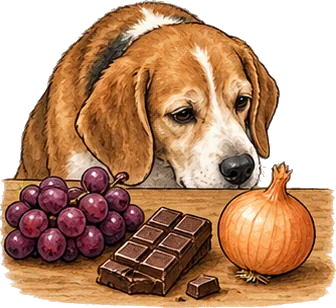
Most kitchen poisonings in dogs come from a short list of foods. Some, like chocolate, depend heavily on the dose. Others, like xylitol and grapes, can cause serious harm in amounts small enough to fit in a pocket. Below is what each food does, how quickly trouble shows up, and when to pick up the phone.
Quick reference: toxic foods, signs, and timing
Use this table to judge urgency, not to rule out a problem. A dog with no signs yet may still need treatment, because several of these poisons work on a delay.
| Food | Toxic part | Main signs | How fast signs appear |
|---|---|---|---|
| Chocolate, cocoa | Theobromine and caffeine (methylxanthines) | Vomiting, diarrhea, thirst, restlessness, racing heart, tremors, seizures | Usually 6 to 12 hours; can last up to 72 hours1 |
| Coffee, tea, energy drinks, caffeine pills | Caffeine | Same as chocolate: panting, hyperactivity, abnormal heart rhythm, tremors2 | Similar to chocolate1 |
| Sugar-free gum, candy, baked goods, some toothpaste | Xylitol | Vomiting, weakness, wobbling, collapse, seizures; later liver injury and bleeding | Low blood sugar within 30 minutes (up to 12 to 18 hours with some gums); liver signs at 24 to 48 hours3 |
| Grapes, raisins, currants, tamarind | Tartaric acid (proposed) | Vomiting, diarrhea, lethargy, belly pain, then little or no urine | Vomiting in 6 to 12 hours; kidney failure in 24 to 72 hours4 |
| Onion, garlic, chives, leeks | Sulfur compounds that damage red blood cells | Weakness, tiring easily, fast breathing, pale or yellow gums, dark urine | Usually 3 to 5 days5 |
| Macadamia nuts | Unknown | Weakness, wobbling, vomiting, tremors, overheating | Within 12 hours; recovery in 24 to 72 hours2 |
| Beer, wine, liquor | Ethanol | Vomiting, stumbling, depression, trouble breathing, tremors, coma | Fast, since alcohol is absorbed quickly2 |
| Raw yeast bread dough | Rising dough plus alcohol from fermentation | Bloated, painful belly; drunk-like signs | As the dough rises in the stomach2 |
| Avocado | Persin; the pit | Vomiting, diarrhea; blockage from a swallowed pit | Varies6 |
| Bones and bone treats | Hard pieces, chunks | Choking, gagging, vomiting, intestinal blockage | Immediate to several days72 |
| Fatty foods (drippings, fat trimmings, nuts) | Fat load | Vomiting, diarrhea, poor appetite; pancreatitis in some dogs | Varies76 |
Chocolate: how much is dangerous
Chocolate risk is a math problem. Vets compare the milligrams of theobromine plus caffeine a dog swallowed with its body weight in kilograms. Mild signs such as vomiting and drinking a lot start around 20 mg/kg. Heart effects show up at 40 to 50 mg/kg, seizures at 60 mg/kg and above, and the dose that kills half of dogs is listed as 100 to 200 mg/kg, though some dogs die at lower amounts1.
Darker chocolate packs more of these stimulants per ounce1:
| Type | Theobromine + caffeine per ounce |
|---|---|
| White chocolate | About 1 mg |
| Milk chocolate | About 64 mg |
| Semisweet chips | 150 to 160 mg |
| Cocoa bean hulls (some garden mulch) | Up to about 255 mg |
| Unsweetened baking chocolate | About 440 mg |
| Cocoa powder | About 807 mg |
Worked example
Take a 40 lb dog. Divide by 2.2 and you get about 18.2 kg.
- If it eats 2 oz of semisweet chips at 160 mg per ounce, that is 320 mg. Dividing 320 by 18.2 gives about 18 mg/kg, just under the mild-signs line. Call anyway, since products vary.
- Now say the same dog eats a 100 g (3.5 oz) bar of 70% dark chocolate. Merck's rule for labeled bars is about 15.5 mg per gram of pure cacao1, so 15.5 x 0.70 x 100 = 1,085 mg. Divided by 18.2 kg, that comes to roughly 60 mg/kg, which is seizure territory. This dog needs to be seen now.
The chocolate toxicity calculator runs this math for you from the wrapper. If you don't have a recent weight for your dog, a guess on the light side is safer, and the dog weight calculator can help you estimate it.
Xylitol: small amounts, fast drop in blood sugar
Xylitol is a sugar substitute found in sugar-free gum and mints, some peanut butters, toothpaste, chewable vitamins, and baked goods3. In dogs it triggers a surge of insulin. Doses above about 0.1 g/kg have been linked to low blood sugar, and some dogs that eat more than 0.5 g/kg go on to severe liver failure3.
For a 20 lb dog (about 9.1 kg), 0.1 g/kg works out to roughly 0.9 g of xylitol. That is less than a gram, and gum makers don't always list the amount per piece. Check the ingredient list on anything sold as sugar-free. Low blood sugar can appear within 30 minutes, and liver damage may not cause visible signs for a day or two3, so a dog that looks normal an hour later is not in the clear. Among dogs that showed signs of liver injury in one study, 62.5% died or were euthanized even with aggressive care3.
Grapes and raisins: the tartaric acid research
For years, nobody could explain why one dog would eat a bunch of grapes with no trouble while another went into kidney failure after a handful of raisins. The leading explanation now is tartaric acid. Dogs can't clear this organic acid from the body efficiently, so it builds up in kidney tubule cells4.
The clue came from dogs that developed acute kidney injury after eating cream of tartar (often in homemade play dough) and tamarinds, both rich in tartaric acid. Wegenast and colleagues published those cases in 2022. A 2023 lab study by Coyne and Landry then found that tartaric acid harmed kidney cells taken from dogs while sparing human kidney cells4. Tartaric acid content differs from fruit to fruit, which fits the uneven pattern vets had seen for decades4.
Merck suggests that more than about one grape or raisin per 10 lb of body weight may carry enough tartaric acid to put the kidneys at risk4. By that guide, more than four grapes could matter for a 40 lb dog. Treat any amount as a reason to call, because outcomes are poor once the kidneys stop making urine4.
Onions and garlic
Every member of the onion family can damage red blood cells and cause anemia, whether raw, cooked, dried, or powdered5. Garlic is 3 to 5 times more potent than onion. Signs have appeared in dogs after 15 to 30 g of raw onion per kg5. For an 18 kg dog, that is about 270 to 545 g, or roughly 0.6 to 1.2 lb of onion. Concentrated forms such as onion soup mix and garlic powder reach those levels faster. Because the anemia shows up 3 to 5 days later5, owners often miss the link to last weekend's leftovers.
Macadamia nuts, alcohol, caffeine, and raw dough
Macadamia nuts cause weakness, vomiting, tremors, and a high body temperature, usually within 12 hours. Dogs typically recover in one to three days2. The bigger danger is chocolate-covered macadamias, which add a second poison.
Alcohol is absorbed quickly and can cause vomiting, poor coordination, breathing problems, and in bad cases coma2. Caffeine from coffee grounds, tea bags, energy drinks, or diet pills behaves like the stimulants in chocolate21.
Raw yeast dough is a double hazard. It keeps rising in the warm stomach, which can stretch it painfully and can even make it twist, an emergency that can kill. The yeast also makes alcohol as it ferments2.
Avocado: less dangerous than its reputation, with exceptions
Persin, the toxin in avocado, is most dangerous to birds, rabbits, horses, and goats62. Dogs are less sensitive and may only vomit or have diarrhea6. The real risks for dogs are the pit, which can lodge in the gut and need surgery, and the fat, which can set off pancreatitis6. Guacamole is a different story, since it usually has onion and garlic mixed in6.
Bones and fatty table scraps
The AVMA warns that bones can make a dog choke or block the intestines7, and ASPCA Animal Poison Control lists raw bones as a source of gut injury and obstruction too2. Ask your vet which chews suit your dog's size and chewing style, and stay in the room while it chews.
Rich scraps such as gravy, poultry skin, and meat fat are hard for dogs to digest and can cause pancreatitis7. Nuts carry enough oil and fat to cause vomiting, diarrhea, and sometimes pancreatitis as well2. Keep table scraps inside the 10% treat allowance the dog food calculator builds in, and skip the fat entirely for a dog that has had pancreatitis before. Extra pounds raise the stakes for many health problems; see is my dog overweight.
What to do right away
- Move your dog away from the food and pick up what's left.
- Gather the facts: what it was, the most it could have been, and what time. Keep the wrapper or package, which shows ingredients, cacao percentage, and weight.
- Call your vet, an emergency clinic, or a poison line now, even if your dog looks normal. ASPCA Animal Poison Control is (888) 426-4435 and Pet Poison Helpline is (855) 764-7661. Both answer 24 hours a day910.
- Expect a fee. ASPCA charges a one-time consultation fee9, and Pet Poison Helpline lists $99 per incident, which covers follow-up calls10.
- If your dog is trembling, collapsing, having a seizure, or has a swollen belly, drive to the nearest emergency vet and call on the way.
Puppies chew and swallow far more than adults, especially while teething (see the puppy teething timeline), and their small size means a lower dose to reach trouble.
Why you shouldn't make your dog vomit at home
Vomiting can help, but only when it's the right call. It works best soon after eating, often within about 2 hours for chocolate1, and it's not safe for every dog or every poison. With xylitol, Merck says a vet should be the one to make the dog vomit, and only while the dog still acts normal3. A dog that is already wobbly, seizing, or very drowsy can inhale vomit into its lungs.
The common home method, 3% hydrogen peroxide, is rougher on the stomach than many owners realize. In a 2017 study, all six healthy dogs given peroxide had visible stomach lining damage at 4 hours, worse at 24 hours, with bleeding and tissue death on biopsy. The lone dog given apomorphine, a drug vets use, showed minimal changes8. Vets also have ropinirole eye drops licensed for dogs4. A poison line or vet can tell you whether vomiting is worth it, and if they advise doing it at home, they will give an exact dose for your dog's weight.
Where these mistakes usually happen
- Waiting for signs. Xylitol, grapes, and onions all do damage before your dog looks sick.
- Guessing the chocolate type. "Dark" bars range widely; check the cacao percentage, and assume the darker option if unsure.
- Forgetting hidden ingredients: xylitol in sugar-free snacks and toothpaste, onion powder in baby food and gravy, raisins in trail mix and bagels, chocolate in protein bars.
- Leaving purses and backpacks on the floor. Gum, mints, and pill bottles inside are easy pickings.
- Assuming a past "safe" grape snack means the next one will be safe too. Tartaric acid levels vary by fruit4.
- Giving hydrogen peroxide, salt, or other home remedies without a vet's dose. Salt itself can poison dogs2.
For new puppies, check what the household eats against this list alongside the feeding plan in how much to feed a puppy, and put the poison line numbers in your phone today.
Common questions
My dog ate one grape. Is that an emergency?
Call your vet or a poison line. Merck suggests that more than about one grape per 10 lb of body weight may carry enough tartaric acid to risk the kidneys, but fruit varies and there is no proven safe amount. If your dog ate it recently, a vet may recommend making it vomit and checking kidney values over the next few days.
How much xylitol is toxic to a dog?
Merck links doses above about 0.1 g per kg of body weight to low blood sugar, and more than 0.5 g per kg to possible liver failure. For a 20 lb dog that first level is under 1 gram, which can be a few pieces of sugar-free gum. Call right away, even before any signs.
Can dogs eat a little cooked onion or garlic?
Cooking does not make onion or garlic safe. Raw, cooked, dried and powdered forms all damage red blood cells, and garlic is several times stronger than onion. A crumb of seasoning is unlikely to matter, but repeated scraps or a dish heavy in onion can add up. Signs of anemia often appear 3 to 5 days later.
Is avocado poisonous to dogs?
Avocado flesh is much less of a problem for dogs than for birds, rabbits and horses. A dog may vomit or get diarrhea. The bigger concerns are the pit, which can block the intestines, the high fat content, which can trigger pancreatitis, and guacamole, which often contains onion and garlic.
Do poison control lines charge a fee?
Yes. ASPCA Animal Poison Control, (888) 426-4435, charges a one-time consultation fee. Pet Poison Helpline, (855) 764-7661, lists $99 per incident, which includes follow-up calls. Both are open 24 hours. Your own vet or an emergency clinic can also advise you and may consult these services for your case.
Should I give my dog hydrogen peroxide to make it throw up?
Only if a vet or poison line tells you to and gives you a dose. In a 2017 study, 3% hydrogen peroxide damaged the stomach lining of every healthy dog given it. Making a dog vomit is also unsafe for some poisons and for dogs that are already drowsy, wobbly or seizing.
 Sources
- Merck Veterinary Manual, Chocolate Toxicosis in Animals
- ASPCA Animal Poison Control, People Foods to Avoid Feeding Your Pets
- Merck Veterinary Manual, Xylitol Toxicosis in Dogs
- MSD Veterinary Manual, Grape, Raisin, and Tamarind Toxicosis in Dogs
- Merck Veterinary Manual, Allium spp Toxicosis in Animals
- Pet Poison Helpline, Can Dogs Eat Avocado?
- American Veterinary Medical Association, Holiday pet safety
- Niedzwecki AH, Book BP, Lewis KM, Estep JS, Hagan J, Effects of oral 3% hydrogen peroxide used as an emetic on the gastroduodenal mucosa of healthy dogs, Journal of Veterinary Emergency and Critical Care, 2017
- ASPCA, Animal Poison Control Center
- Pet Poison Helpline, home page and fee information
General information, not veterinary advice. If your pet is unwell, call your vet.
