
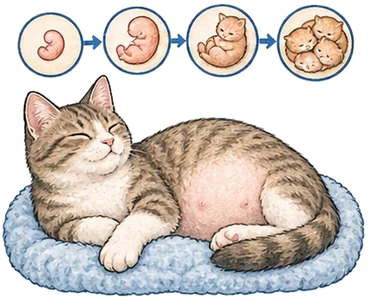
A cat is pregnant for about 65 days, a little over nine weeks, counted from the first mating, and nearly all queens (breeding females) deliver between day 61 and day 70.23 Our cat pregnancy calculator turns a mating date into a likely due date and a window around it. A vet can confirm the pregnancy by day 21 to 30, and labor opens with 12 to 24 hours of hiding and restlessness before the first kitten.1
How long are cats pregnant, and how sure is the date?
Less sure than one number suggests. In a UK questionnaire of pedigree breeders covering 1,056 litters, pregnancy averaged 65.1 days from the first mating. Nine in 10 recorded lengths fell between day 63 and 67, and 97% between day 61 and 69.2 A 2022 veterinary review gives about 65 days, with a range of 57 to 72 and 95 to 97% of births between day 61 and 70.3 Merck puts birth at 64 to 66 days after the hormone surge that mating sets off.10
Part of the spread comes from the counting. Cats ovulate in response to mating, and Merck recommends spreading breedings across 2 to 3 days, noting that the breeding date doesn't always match conception.1 Count from the first mating, as the UK survey did. Its authors cite an earlier suggestion that the often-quoted 63 days may come from counting from the last mating instead.2 Breed matters too: Siamese and Oriental Shorthair queens averaged over 66 days, Korats 63.2
Day 65 is the best single guess, and a few days either side is normal.2 The 2022 review advises a cesarean on day 71 after mating when there are still no signs that labor is near, to avoid losing kittens.3 So if she reaches day 70 with no sign of labor, call your vet that day, and call sooner if she seems unwell. At the far end, both pregnancies recorded at 80 days in the UK survey produced only dead kittens.2 For a first mating on 1 March, day 65 is 5 May and day 70 is 10 May.
If you don't know when she mated, as with a stray, a vet can estimate how far along she is by measuring the fetal sacs or, later, the kittens' heads on ultrasound, though the estimate gets less accurate close to term.3 A rough idea of when she was in heat can also help, and the guide to how long a cat stays in heat explains the timing.
Cat pregnancy week by week
Days count from the first mating, and all timings are approximate.
| Week (days) | What is happening | What to do |
|---|---|---|
| 1 (1 to 7) | Mating triggers ovulation.1 No signs yet. | Write down every mating date. |
| 2 (8 to 14) | Implantation in the uterus can take up to two weeks.4 Ultrasound can show the first gestational sacs from day 10.3 | Keep her routine. Her food needs are already starting to rise.6 |
| 3 (15 to 21) | Nipples may start to pink up.5 Ultrasound can show heartbeats from day 16 to 17.3 | Book the confirmation visit and ask about kitten food. |
| 4 (22 to 28) | Feeling the belly works best on days 21 to 25.3 Her weight is rising in a steady line.6 | Vet confirmation, day 21 to 30.1 |
| 5 (29 to 35) | A relaxin blood test works from day 29, and palpation gets harder after day 35.3 | Weigh her weekly and keep a log. |
| 6 (36 to 42) | Her belly grows more obvious as the kittens develop.4 | Keep raising her food gradually. |
| 7 (43 to 49) | Kitten skeletons can show on X-ray from about day 45.4 | Feed about 25% more than usual.1 Keep her apart from other cats for at least her final 2 to 3 weeks.3 |
| 8 (50 to 56) | An X-ray after day 55 can help count the kittens.1 | Set out the nesting box. |
| 9 and 10 (57 to 70) | Most births fall between day 61 and 70, around day 65 on average.23 Nesting usually begins 12 to 48 hours before the birth.4 | Keep your vet's number handy, and call if labor hasn't started by day 70.3 |
How soon can you tell a cat is pregnant?
Pinker, slightly more prominent nipples are an early sign,45 and ultrasound can show the first sacs from day 10.3 Her heat cycles stop.4 Over the following weeks her belly fills out and she usually eats more, and some queens vomit now and then, but a false pregnancy can copy several of these signs.4
| Check | When it works | What it tells you |
|---|---|---|
| Pink nipples ("pinking up") | About 15 to 18 days after ovulation5 | A hint only, since a false pregnancy can cause it too4 |
| Scale | A steady climb from early on, up to about 38% above her starting weight by term7 | Steady gain, if you know her pre-mating weight |
| Feeling the belly | Possible from day 15, easiest around days 21 to 25, hard after day 353 | Swellings along the uterus |
| Ultrasound | Sacs from day 10, heartbeats from day 16 to 173 | Pregnancy, and whether the kittens are alive3 |
| Relaxin blood test | Day 29, with a test made for dogs3 | Pregnant or not |
| X-ray | Skeletons from about day 45;4 a count after day 551 | How many kittens to expect1 |
That pinking-up timing rests on one figure caption in a BSAVA veterinary book, not a study, so treat it as approximate.
What to feed a pregnant and nursing cat
Vets usually recommend kitten food through pregnancy and nursing, so ask about switching her once the pregnancy is confirmed.1 On the label, look for an adequacy statement that says "growth and reproduction," the AAFCO profile that covers growing, pregnant and nursing animals.8
A queen gains weight in a straight line from early pregnancy, so her needs rise almost right away.6 In the final third, intake rises about 25% on average, Merck says, and some estimates run as high as 40% above maintenance;6 a review gives 25 to 50% by term.7 Some queens eat less early on and just before labor, which matters only if it lasts.6 She should start in good condition, since obesity is linked to difficult births and stillbirths.3
Nursing costs more. Merck says a nursing queen needs 2 to 3 times her normal food, depending on litter size.6 The review gives it week by week: 1 to 1.5 times maintenance in the first week of lactation, 2 times in the second, and 2.5 to 3 times in weeks 3 and 4.7 Feed her free choice or in several small meals, with water always available, since milk is 78% water.67 She will probably lose weight while nursing anyway, so reserves built during pregnancy help.1
Worked example. Take a 7 lb (3.2 kg) intact queen. The cat food calculator gives a cat like her 230 to 270 calories a day when she is not pregnant. It does not cover pregnancy or nursing, so use it only for that baseline, and call it 250. At term, 25 to 50% more is 250 × 1.25 = about 310 up to 250 × 1.5 = 375 calories a day. In weeks 3 and 4 of nursing, 2.5 to 3 times is 250 × 2.5 = 625 up to 250 × 3 = 750. Her weight is the check: queens typically gain up to about 38% by term, which takes 3.2 kg to as much as 4.4 kg (9.7 lb).7 The guide to how much to feed a cat covers turning calories into cups or cans.
Setting up a nesting box
Pick a quiet, dim spot and put in a box lined with towels or blankets.4 Set it out early so she can get used to it. Merck advises a familiar place where nobody disturbs her, since strangers and new surroundings can slow delivery and, especially with a first litter, lead her to neglect the kittens.1
If other cats share the house, separate her from them for the last half of pregnancy if you can, mainly to cut the risk of upper respiratory infections.1 The kitten care guide has nest temperatures for the first weeks.
Signs of labor and what each stage looks like
Labor has three stages, and a queen moves back and forth between the last two.9
- Stage 1, 12 to 24 hours. Contractions start but you cannot see them. She hides, paces and nests, may vomit or tremble, and often refuses food. Any discharge is clear and watery.9
- Stage 2, the kittens. Her belly visibly tightens as she pushes. In a normal labor Merck expects 30 to 60 minutes between kittens, with visible straining lasting no more than 1 to 2 hours before each one. Ideally the whole litter is out in 7 to 9 hours.9 Half of all gaps last 30 minutes or less, according to the 2022 review, and 95% of kittens come within 100 minutes of the one before.3
- Stage 3, the placentas. Placentas may be eaten, pass unnoticed or come out within 24 hours, and she does not need to eat them.9
Among UK queens that delivered without help, 74% of gaps between kittens lasted under an hour and 21% lasted 1 to 3 hours, while 13 of 1,001 ran 12 hours or longer, three of them a full day or more.2 The authors say gaps that long can be normal but are very rare, and that a long normal labor is hard to tell apart from a problem.2
In dogs, rectal temperature usually falls 8 to 24 hours before the birth, after progesterone drops, and Merck describes that sign for dogs only.10 For cats, a 2022 review says progesterone can't be used to predict birth,3 and none of the sources behind this guide gives a temperature drop for queens. Go by what she does. The dog pregnancy guide covers the temperature check.
How many kittens will she have?
The average litter in the UK survey was 4.6 kittens, with a range of 1 to 13.2 Breed shifts the number: Birmans averaged 3.6 and Persians 3.8, while Burmese averaged 5.7 and the Asian group 6.5.2 An X-ray after day 55 gives you a count to check against during labor.1
When to call the vet
About 8% of litters in the UK survey ended in a cesarean, and owners sought veterinary help for about 15%.2 Phone your vet or an emergency clinic right away if:
- She reaches day 70 from the first mating with no sign of labor, since a cesarean is advised on day 71.3
- Stage 1 runs past 24 hours without a kitten.1
- She pushes visibly for 1 to 2 hours with no kitten, or a gap between kittens passes the 1 to 4 hours that Merck counts as prolonged labor; the shorter end is the safer one to act on.19
- Discharge turns green, which Merck lists as abnormal.9
- Kittens arrive dead or barely alive, or she shows extreme distress.1
Afterward, a dark red to black discharge with no smell is normal for a few days.9 Call if she keeps straining, runs a fever or seems depressed, since those can signal an inflamed uterus.1 Tremors, twitching or seizures in the following days can mean low blood calcium.1 Weigh each kitten as soon as it dries, then twice a day for the first week. Kittens should gain about 10% of body weight daily, and one that loses weight after its first day needs attention.1 The kitten weight chart shows the usual range for each age.
Common questions
Can a cat have a false pregnancy?
Yes. Cats ovulate when they mate, and if that does not lead to a pregnancy, progesterone still rises, though less than in a real one, then falls to low levels after 40 to 45 days.3 Pink nipples and other signs can copy pregnancy.4 A vet can tell the two apart with an ultrasound or, from day 29, a relaxin blood test.3
Can a pregnant cat be spayed?
Yes. Merck says spaying can end a pregnancy, and a vet can also end one with the hormone prostaglandin F2-alpha.1 Neither is a home decision. If the kittens are unwanted, call a clinic as soon as you know she is pregnant and ask what is possible at her stage.
Does a pregnant cat need calcium or vitamin supplements?
No. Merck advises a complete, balanced food and no added calcium or vitamins.1 Calcium supplements or an unbalanced diet during pregnancy raise the risk of low blood calcium after delivery.1 Too little taurine can cause early embryo loss. Commercial cat food usually has enough, but a homemade diet needs checking.7
Can I deworm a pregnant cat?
Ask your vet first. Roundworm larvae can pass to kittens in the mother's milk.3 One 2022 review recommends a single emodepside spot-on about 7 days before the due date, or treating the kittens instead, and notes that practice depends on local rules and risk.3 Which product to use, and when, is your vet's call.
See Cat nesting boxes on Amazon. As an Amazon Associate we earn from qualifying purchases.
 Sources
- Davidson AP, Management of Reproduction of Cats, Merck Veterinary Manual (pet owner version), reviewed 2018, updated 2025
- Sparkes AH, Rogers K, Henley WE, et al., A questionnaire-based study of gestation, parturition and neonatal mortality in pedigree breeding cats in the UK, Journal of Feline Medicine and Surgery 8(3):145-157, 2006
- Ström Holst B, Feline breeding and pregnancy management: what is normal and when to intervene, Journal of Feline Medicine and Surgery 24(3):221-231, 2022
- Sharma D, Rutgers University, Basics of Pregnancy and Birth in the Cat, eXtension, undated
- British Small Animal Veterinary Association (BSAVA Library), Management of reproduction and related disorders, chapter 15, Figure 15.2 caption on pinking of the nipples
- Sanderson SL, Feeding Practices in Small Animals, Merck Veterinary Manual (professional version), reviewed 2023, updated 2024
- Fontaine E, Food intake and nutrition during pregnancy, lactation and weaning in the dam and offspring, Reproduction in Domestic Animals 47(Suppl 6):326-330, 2012
- US Food and Drug Administration, "Complete and Balanced" Pet Food, content current as of February 2020
- Davidson AP, Labor, Delivery, and Postpartum Care in Bitches and Queens, Merck Veterinary Manual (professional version), reviewed 2025, updated 2026
- Davidson AP, Whelping and Queening in Bitches and Queens, Merck Veterinary Manual (professional version), reviewed 2025, updated 2026
General information, not veterinary advice. If your pet is unwell, call your vet.
