
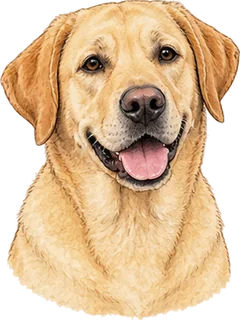
The thick, tapering otter tail on a Labrador works as a rudder when it swims, a leftover from dogs that pulled fish and ducks out of the North Atlantic. Labs measure 21.5 to 24.5 inches tall at the withers and come in black, yellow, or chocolate. Their easygoing manners hide a big appetite for exercise.
Labrador Retriever weight by age
| Age | Male | Female |
|---|---|---|
| 2 months | 14 lbrange 9.5–18 lb | 12 lbrange 8.4–16 lb |
| 3 months | 22 lbrange 16–29 lb | 20 lbrange 14–26 lb |
| 4 months | 32 lbrange 24–40 lb | 28 lbrange 22–35 lb |
| 5 months | 42 lbrange 34–50 lb | 37 lbrange 30–45 lb |
| 6 months | 48 lbrange 39–58 lb | 43 lbrange 35–51 lb |
| 8 months | 59 lbrange 50–68 lb | 52 lbrange 44–60 lb |
| 10 months | 64 lbrange 54–72 lb | 56 lbrange 48–63 lb |
| 12 months | 66 lbrange 57–74 lb | 58 lbrange 51–64 lb |
Half of adult weight comes by about 4 months, 90% by about 11 months and 95% by about 16 months.
Adult weight
AKC breed page: 65-80 pounds (male), 55-70 pounds (female).
 About the Labrador Retriever
Labs started as the working water dog of Newfoundland, riding fishing boats to grab fish that slipped off the lines and retrieving ducks for hunters. English nobles visiting Canada in the early 1800s took some home, and British breeders refined the type during the second half of the century. Nobody is sure how a Newfoundland dog ended up named for Labrador. The short, dense coat was a deliberate choice: longhaired retrievers came out of icy water crusted with ice. England's Kennel Club accepted the breed in 1903; the AKC's first Lab registration came in 1917. Labs first led AKC registrations in 1991 and held the top spot for 31 straight years.
 Build, coat and exercise
This is a sturdy, balanced dog with a wide head and a dense, hard, water-repellent double coat. It sheds, so expect hair around the house, but grooming is simple: occasional baths, regular nail trims, and frequent tooth brushing. Exercise is the real commitment. Labs need a lot every day, and their favorite outlets are swimming and retrieving. A bored Lab tends to turn its energy on furniture and shoes. Many also do dock diving, tracking, hunt tests, and service or detection work.
 Raising a Labrador Retriever puppy
Labs grow into strong, energetic dogs, so the AKC calls early socialization and puppy classes vital. The best window for gentle exposure to new people, places, and situations runs from about 7 weeks to 4 months, and obedience work should start early too. Many Labs gain weight easily, and training treats add up fast, so watch the daily total. Exercise-induced collapse can show up in young adult Labs during intense activity. A DNA test identifies carriers, so ask whether the parents were tested. Deep-chested Labs can also bloat, which is worth learning to recognize.
 Health and care notes
- Hip and elbow dysplasia. Malformed hip or elbow joints can lead to lameness and arthritis. Ask to see OFA hip and elbow results for both parents.
- Exercise-induced collapse (EIC). Affected dogs lose control of their hind legs after intense exercise, usually as young adults. A DNA test is available, and the Labrador Retriever Club recommends it for breeding dogs.
- Progressive retinal atrophy. PRA is a gradual loss of the retina that leads to blindness. Look for parents with a PRA-prcd DNA result and a current eye exam by a veterinary ophthalmologist.
- Centronuclear myopathy. This inherited muscle disease causes weakness. The breed club lists a CNM DNA test among its recommended screenings.
See Large-breed puppy food on Amazon. As an Amazon Associate we earn from qualifying purchases.
Breed background: AKC: Labrador Retriever breed page; AKC Sporting Group health testing requirements. Weight standard: AKC breed page. Growth curves: our analysis of Salt et al. (2017) data. Methods.
