
A Maltipoo comes from a Maltese crossed with a Toy or Miniature Poodle, and which Poodle is used has a lot to do with how big the puppy gets. Adults stand roughly 8 to 14 inches. Most are white, thanks to the Maltese side, and the coat can be curly like a Poodle's or straight and silky like a Maltese's.
Maltipoo weight by age
| Age | Typical weight |
|---|---|
| 2 months | 3.6 lbrange 2.5–5.0 lb |
| 3 months | 5.3 lbrange 3.8–7.0 lb |
| 4 months | 6.9 lbrange 5.3–8.8 lb |
| 5 months | 8.5 lbrange 6.8–10 lb |
| 6 months | 9.5 lbrange 7.7–11 lb |
| 8 months | 11 lbrange 9.0–12 lb |
| 10 months | 11 lbrange 9.6–13 lb |
| 12 months | 12 lbrange 10–13 lb |
Half of adult weight comes by about 4 months, 90% by about 9 months. The last few percent come on slowly after that.
Adult weight
PetMD: 5-20 pounds. These are association or industry size guides for a mixed breed, so individual dogs vary more than for a purebred.
 About the Maltipoo
The cross appears to have started in the United States in the late 1990s, according to Hill's, with the goal of a small, affectionate companion with a low-shedding coat. Breeders chose the Maltese for temperament and looks and the Poodle for intelligence and low-shedding hair. Popularity has grown a great deal since. Because the Poodle parent can be a Toy or the larger Miniature, adult size spreads widely, from about 5 to 20 pounds. First-generation crosses do not breed true, and the Dog Aging Project notes that later generations, or crosses back to a Poodle, can show an even wider range or lean toward Poodle coat traits.
 Build, coat and exercise
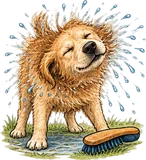
Maltipoos are small dogs with a low-shedding coat that still needs plenty of upkeep. Brush daily with a wire slicker, since mats are painful to work out, and plan a professional groom every four to six weeks; a short puppy cut reduces the work. Wipe tear stains as needed and clean the ears after baths, because hair in the ear canal makes infections common. Exercise needs are modest. A daily walk plus backyard play usually covers it, and puzzle toys or a snuffle mat add mental work.
 Raising a Maltipoo puppy
Young Maltipoos need frequent meals. PetMD advises four a day for puppies to help prevent hypoglycemia, or low blood sugar, then three smaller meals and finally two as adults. Measure portions and count training treats, because the breed gains weight easily; praise and toys work as rewards too. Maltipoos are sensitive to changes in routine and can develop separation anxiety, so crate train early and build up time alone gradually. Supervise young children, who can hurt a dog this small by accident. Expect some alert barking.
 Health and care notes
- Patellar luxation. Both possible parents carry this risk: patella exams are on the Maltese club's short list of tests and on the Toy Poodle club's list too. A Maltipoo that skips on a back leg should have its knees checked by a vet.
- Progressive retinal atrophy. An inherited loss of vision from the Poodle side. The Poodle club recommends a PRA-prcd DNA test for Toy and Miniature Poodles.
- Liver shunt. This liver problem comes through the Maltese parent. The Maltese club recommends a serum bile acids blood test, and OFA suggests running it as a paired test, so ask whether the Maltese parent had it.
- Heart disease. The Maltese club also recommends a cardiac exam for breeding dogs. Ask for the parents' results and have your vet listen to the puppy's heart.
See Small-breed puppy food on Amazon. As an Amazon Associate we earn from qualifying purchases.
Breed background: PetMD: Maltipoo; Hill's Pet Nutrition: Maltipoo; Dog Aging Project: The genetics of novel dog crosses; AKC Toy Group health testing requirements. Weight standard: PetMD. Growth curves: our analysis of Salt et al. (2017) data. Methods.
