
A Mini Labradoodle gets its smaller size from the Poodle side: it comes from a Labrador Retriever crossed with a Miniature Poodle instead of a Standard. Minis stand about 16 to 20 inches and top out around 30 pounds, with a coat that can be tightly curled or loose and wavy.
Labradoodle (mini) weight by age
| Age | Typical weight |
|---|---|
| 2 months | 6.0 lbrange 4.0–8.3 lb |
| 3 months | 9.2 lbrange 6.6–12 lb |
| 4 months | 13 lbrange 9.7–16 lb |
| 5 months | 16 lbrange 13–20 lb |
| 6 months | 18 lbrange 15–22 lb |
| 8 months | 22 lbrange 18–25 lb |
| 10 months | 23 lbrange 20–26 lb |
| 12 months | 24 lbrange 21–26 lb |
Half of adult weight comes by about 4 months, 90% by about 10 months. The last few percent come on slowly after that.
Adult weight
PetMD: mini up to 30 pounds. These are association or industry size guides for a mixed breed, so individual dogs vary more than for a purebred.
 About the Labradoodle (mini)
Every Labradoodle traces back to a 1989 experiment at Guide Dogs Victoria in Australia, where breeding manager Wally Conron crossed a Labrador with a Standard Poodle. A blind woman in Hawaii had asked for a guide dog her allergic husband could live with, and one puppy from the first litter, Sultan, fit the bill. Minis use a Miniature Poodle to bring size down, and with parents of such different sizes, adult size can vary. A first-generation (F1) cross does not breed true, and the Dog Aging Project notes that F1 littermates can look quite different. Breeding back to a Poodle (F1B) raises the share of Poodle genes and Poodle coat traits, while the same article warns that crossing two Labradoodles can produce an even wider spread of traits.
 Build, coat and exercise
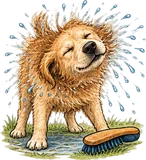
Expect a dog of 16 to 20 inches with a coat that ranges from tight curls to loose, flowing locks. Shedding is usually low but varies by coat type and by dog, and PetMD points out that hypoallergenic is a marketing term, not a guarantee. Brush at least twice a week, or daily if the coat mats, paying attention to the ears, rear, and inner legs, and plan a professional groom every two to three months. Keep the fringe trimmed so the dog can see. Plan on an hour or more of activity daily, split between one or two walks and fetch sessions, plus some mental work.
 Raising a Labradoodle (mini) puppy
Mini Labradoodles are smart and eager to please, so positive training can start the day the puppy comes home. Introduce other animals and small children gradually. These dogs do poorly when left alone for long stretches, and crate training plus interactive toys can help a puppy learn to cope. Puppies under 6 months may need more frequent meals than the two a day adults get, and treats should stay under 10 percent of daily calories. Clean the ears after baths and swims, because ear infections are a known problem in Labradoodles.
 Health and care notes
- Hip dysplasia. PetMD lists hip dysplasia among Labradoodle problems, and the Poodle club recommends hip evaluations for Miniature Poodles. Ask for OFA or PennHIP results on both parents.
- Patellar luxation. Slipping kneecaps come from the Miniature Poodle side, and the Poodle club recommends patella evaluations for Toys and Minis. Have your vet check the knees as the puppy grows.
- Progressive retinal atrophy. An inherited loss of vision. The Poodle club recommends a PRA-prcd DNA test for Miniature Poodles, and PetMD notes eye exams for Labradoodle breeding dogs.
- Heart disease. PetMD names valve disease, arrhythmia, and dilated cardiomyopathy as concerns in Labradoodles and suggests breeders use echocardiograms. Ask whether the parents were screened.
See Medium-breed puppy food on Amazon. As an Amazon Associate we earn from qualifying purchases.
Breed background: PetMD: Labradoodle; Man who bred first Labradoodle (WSET/Sinclair); Dog Aging Project: The genetics of novel dog crosses; AKC Non-Sporting Group health testing requirements. Weight standard: PetMD. Growth curves: our analysis of Salt et al. (2017) data. Methods.
