
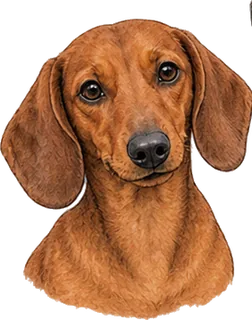
At 16 to 32 pounds, the standard Dachshund is the size that went to ground after badgers, animals that can weigh 25 to 40 pounds and fight hard. It stands about 8 to 9 inches tall. That loud, houndy bark had a job too: it told the hunter above ground where the dog was working below.
Dachshund (Standard) weight by age
| Age | Typical weight |
|---|---|
| 2 months | 5.7 lbrange 3.8–7.9 lb |
| 3 months | 8.7 lbrange 6.2–12 lb |
| 4 months | 12 lbrange 9.1–15 lb |
| 5 months | 15 lbrange 12–18 lb |
| 6 months | 17 lbrange 14–21 lb |
| 8 months | 20 lbrange 17–23 lb |
| 10 months | 22 lbrange 18–24 lb |
| 12 months | 23 lbrange 20–25 lb |
Half of adult weight comes by about 4 months, 90% by about 10 months. The last few percent come on slowly after that.
Adult weight
AKC breed page: 16-32 pounds (standard), 11 pounds & under (miniature).
 About the Dachshund (Standard)
German hunters spent centuries shaping this badger dog, and the breed's history there runs back some 600 years. Courage and stamina mattered because the quarry fought back with teeth and claws. Breeders later added a wire coat for working through brambles and a long coat for cold weather, alongside the original smooth. Breed authorities say packs of Dachshunds were sometimes turned loose on wild boar. Breeders were well along in standardizing size, coat, and color by the late 1800s, and the AKC admitted the breed in 1885. During World War I, anti-German feeling led some American fans to call them Liberty Hounds.
 Build, coat and exercise
Standards are long and low, and well muscled when kept fit. They are not designed for distance running, big leaps, or hard swimming, though they will try almost anything else. Smooth coats need only a quick wipe; longhaired coats need regular brushing; wirehaired coats are hand-stripped a few times a year and combed weekly. Shedding is moderate and odor is low. Two moderate walks a day help build the back muscles that protect the spine, and stairs and furniture jumps should be avoided.
 Raising a Dachshund (Standard) puppy
Puppy bones and muscles are still developing until roughly one year, according to the breed club, so increase walks gradually rather than all at once. Keep a growing standard off stairs and teach it to wait to be lifted onto furniture. Weight is the biggest lever an owner controls: scheduled, measured meals beat free-feeding, and table scraps should be rare. Training calls for patience, since these hounds were bred to follow a trail without distraction. Reward-based methods work far better than harsh commands. A strong prey drive means a leash or secure fence outdoors.
 Health and care notes
- Intervertebral disc disease (IVDD). Disc damage in the long back is the breed's best-known problem and can cause pain or paralysis. Keep the dog lean, discourage jumping, and treat sudden back pain as urgent.
- Ear infections. The AKC notes that the Dachshund's drop ears can get infected if they aren't kept clean. Make a quick look and wipe part of the weekly routine.
- Mitral valve disease. The parent club lists this heart valve condition, and it recommends cardiac exams for breeding dogs. Ask for the parents' results.
- Hemangiosarcoma. The Dachshund Club of America lists this cancer of the blood vessel cells among breed concerns. Yearly wellness exams give your vet a chance to catch problems early.
See Medium-breed puppy food on Amazon. As an Amazon Associate we earn from qualifying purchases.
Breed background: AKC: Dachshund breed page; Dachshund Club of America: Health; AKC Hound Group health testing requirements. Weight standard: AKC breed page. Growth curves: our analysis of Salt et al. (2017) data. Methods.
