
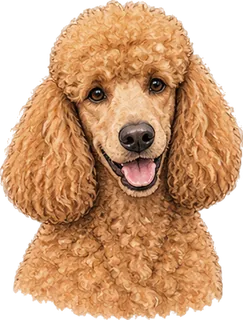
The Standard is the original Poodle, a German water retriever with more than 400 years behind it and the only variety taller than 15 inches. Its showy clip started as a practical hunting haircut. Of the three sizes, the AKC calls the Standard the best all-around athlete, and it still qualifies for retriever hunting tests.
Poodle (Standard) weight by age
| Age | Male | Female |
|---|---|---|
| 2 months | 13 lbrange 8.7–17 lb | 9.4 lbrange 6.5–13 lb |
| 3 months | 20 lbrange 15–27 lb | 15 lbrange 11–20 lb |
| 4 months | 29 lbrange 22–36 lb | 21 lbrange 16–27 lb |
| 5 months | 38 lbrange 31–46 lb | 27 lbrange 22–33 lb |
| 6 months | 44 lbrange 36–53 lb | 32 lbrange 26–38 lb |
| 8 months | 54 lbrange 46–62 lb | 38 lbrange 32–43 lb |
| 10 months | 58 lbrange 50–65 lb | 40 lbrange 35–45 lb |
| 12 months | 60 lbrange 52–67 lb | 42 lbrange 37–46 lb |
Half of adult weight comes by about 4 months, 90% by about 10 months and 95% by about 14 months.
Adult weight
AKC breed page: 60-70 pounds (male standard), 40-50 pounds (female standard).
 About the Poodle (Standard)
Poodles were bred in Germany to fetch ducks from the water; the German word pudelin refers to splashing. Hunters wanted the dogs to swim freely but stay warm, so the legs, neck, and tail were clipped while hair stayed over the chest, hips, and joints. The rounded tufts that remain are called pompons, and the modern show clip grew out of that working cut. France later made the Poodle its national dog under the name Caniche. Standards were popular with French and European nobility, worked in circuses, and used their noses to find truffles. Breeders later scaled the Standard down to create the Miniature, and the Toy followed in America.
 Build, coat and exercise
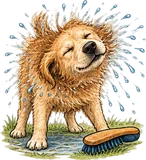
Standards are squarely built and smoothly muscled, and they move with an athletic stride. The curly coat sheds very little, but it mats at the skin unless it is brushed and combed thoroughly or clipped short. Most pet owners choose a short trim and a groomer visit every four to six weeks. Daily exercise needs are high. Swimming, retrieving games, jogs, and long walks all suit a Standard, and many compete in dock diving, agility, obedience, and hunt tests.
 Raising a Poodle (Standard) puppy
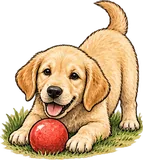
Standard puppies are smart and quick to pick up both good habits and bad ones, so keep training fun, positive, and consistent from day one. Get the puppy comfortable with brushing, bathing, and the sound of clippers early, since grooming is lifelong. Standards are more prone to bloat than the smaller Poodles, so learn the warning signs before your dog reaches adult size. For Standards only, the breed club also lists a NEwS DNA test, which screens for a fatal seizure disorder of newborn puppies (neonatal encephalopathy with seizures); ask whether the parents were tested or are clear by parentage. Watch treat totals, since some Poodles put on weight.
 Health and care notes
- Hip dysplasia. The Poodle Club of America lists a hip evaluation for Standards along with eye, thyroid, NEwS, and vWD I testing. Ask for both parents' OFA or PennHIP hip results.
- Sebaceous adenitis. An inflammatory disease of the skin's oil glands that the AKC says is seen more often in Standards. Ask whether skin problems run in the puppy's family.
- Bloat. Standards are more likely than Toys or Miniatures to suffer this sudden, life-threatening swelling and twisting of the stomach. Learn the signs and know where the nearest emergency vet is.
- von Willebrand's disease. An inherited clotting disorder that can cause excess bleeding after injury or surgery. A DNA test (vWD I) is on the club's list of recommended screenings for Standards.
See Large-breed puppy food on Amazon. As an Amazon Associate we earn from qualifying purchases.
Breed background: AKC: Poodle (Standard) breed page; AKC Non-Sporting Group health testing requirements. Weight standard: AKC breed page. Growth curves: our analysis of Salt et al. (2017) data. Methods.
